
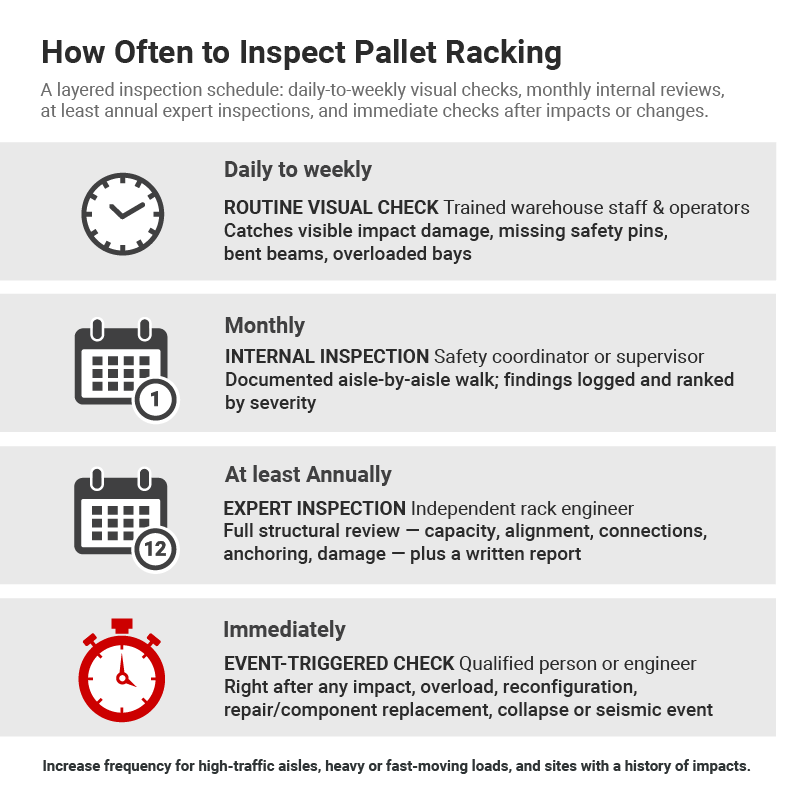
Short answer: Damotech recommends a documented inspection by an independent third-party rack expert or engineer at least annually, supported by monthly internal inspections and daily-to-weekly visual checks by trained staff. Report impacts, suspected overloads, and visible damage immediately so the affected area can be assessed promptly. New installations, repairs, and reconfigurations should be checked before use. Adjust the schedule to your operating risks, manufacturer guidance, and applicable requirements.
That’s the headline. Below is what actually drives the schedule, how OSHA, ANSI/RMI, and CSA influence inspection expectations, and the events that should trigger an inspection regardless of the calendar.
Pallet rack inspection frequency at a glance
| Inspection type | Who performs it | How often (typical) | What it looks for |
|---|---|---|---|
| Routine visual check | Trained warehouse staff, supervisors, or operators reporting visible damage | Daily to weekly | Obvious damage — bent uprights, dented beams, missing safety pins, overloaded bays, blocked aisles |
| Internal/operational inspection | In-house safety coordinator or supervisor | Monthly | Documented walk of every aisle, findings logged and classified by severity |
| Expert inspection | Independent third-party rack expert or engineer | At least annually | Detailed visual condition and conformity assessment covering damage, alignment, connections, anchoring, capacity documentation, and observed use, documented in a written report |
| Event-triggered inspection | Qualified person or engineer, per the event | Immediate reporting and protective action; prompt qualified assessment | Condition assessment after impacts, suspected overloads, or seismic events; verification of completed repairs or reconfigurations before use |
This table outlines a recommended inspection program. Applicable requirements and site conditions may call for different intervals or qualifications. Routine visual checks, documented internal inspections, and expert reviews complement one another and help identify damage and track corrective actions.
What actually sets the frequency
There is no fixed "inspect every X weeks" rule that applies everywhere. Frequency should scale to your operation. Increase it when you have:
- High forklift traffic or narrow aisles.
- A history of impacts in the same zones ("recurring hit zones").
- Heavy, dense, or fast-moving inventory.
- Multiple shifts or seasonal volume spikes.
- Recent layout changes, repairs, or new hires operating equipment.
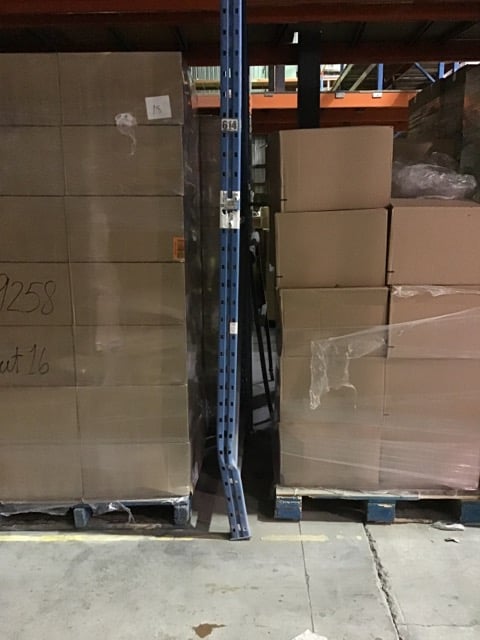
The busier and more damage-prone the site, the shorter the interval between checks. A slow, low-traffic storeroom and a 24/7 e-commerce fulfillment center should not be on the same schedule.
What OSHA, ANSI/RMI, and CSA say about rack inspection frequency
This is where most confusion starts, because people mix up law, consensus standard, and best practice. Here’s the clean version.
United States — OSHA + ANSI/RMI MH16.1
OSHA does not publish a pallet-rack-specific inspection interval. Instead, rack safety is usually evaluated through the employer’s general duty to provide a workplace free from recognized serious hazards, along with applicable material-handling rules such as 29 CFR 1910.176.
OSHA has used the General Duty Clause to cite storage-rack hazards such as racks not anchored to the floor, missing load-capacity markings, and damaged columns, and those citations have named following ANSI MH16.1 as one acceptable way to correct the hazard.
A key technical benchmark in the U.S. is ANSI/RMI MH16.1 — Design, Testing, and Utilization of Industrial Steel Storage Racks, developed by the Rack Manufacturers Institute. It is a consensus standard, not an OSHA regulation, but OSHA lists it among the national consensus standards relevant to warehousing. The International Building Code also references MH16.1 for rack design, so in jurisdictions that adopt the IBC, its design and installation provisions can be enforced through the building code.
RMI’s published guidance sets a floor: the rack owner should run regularly scheduled inspections by a qualified person at least once a year, and more often as damage potential rises. RMI rates damage potential by six risk areas: high forklift traffic, high inventory turnover, narrow aisles, transfer areas, aisle ends, and rack entry points. It suggests monthly inspections where four or more apply, quarterly for three, twice a year for two, annually otherwise, and immediately after any seismic event. As a practical baseline, many facilities use a full annual rack inspection, more frequent internal checks in high-risk areas, and immediate isolation of damaged rack portions until they are evaluated and repaired or replaced.
OSHA’s National Emphasis Program on Warehousing and Distribution Center Operations, launched in 2023 and revised effective July 31, 2026 for another five years, keeps powered industrial vehicles and material handling and storage among its inspection focus areas.
Canada — CSA A344 + provincial OHS
In Canada, the key user document is CSA A344:24, User guide for steel storage racks. CSA describes it as the second edition of CSA A344, replacing the 2017 edition and CSA A344.1:2005. It should be read alongside the applicable provincial occupational health and safety requirements and the authority having jurisdiction for your facility.
CSA A344:24 is written as guidance: its “should” statements are recommendations, not requirements. It supports a documented rack inspection program that combines routine inspections by trained staff with more detailed inspections by people with specialized rack knowledge. Legal inspection duties come from provincial OHS rules.
For rack design, the requirements formerly in CSA A344.2 moved into CSA S16, Annex N, which has since been replaced by CSA S345:23, Design and construction of steel storage racks. S345 covers selective-type racks (including double-deep, push-back, pallet flow, VNA, and AS/RS racks) but not cantilever, drive-in/drive-through, or portable racks. Because building-code adoption and enforcement can vary by province, rack type, facility use, and the authority having jurisdiction, confirm the applicable requirements with a qualified rack professional or professional engineer.

When to Call a Rack Inspector: Events That Trigger an Inspection
Frequency handles the routine. These events should trigger an inspection on their own — and several are also the moments when a third-party rack inspector or engineer is the right call. When any of these apply, book a rack inspection with Damotech.
- After a new rack installation — verify everything was installed to the manufacturer's plans and specs before the system carries load.
- As a corporate safety baseline — a point-in-time assessment across one or many sites, so you can measure progress and compare facilities on a uniform basis.
- On a scheduled re-assessment — annual, quarterly, or monthly re-checks to catch new damage and update the status of previously flagged issues.
- For a regulatory compliance review — written documentation from a qualified professional that records rated capacities, inspection findings, and corrective actions. In Ontario, installing or modifying racking can trigger a Pre-Start Health and Safety Review (PSR), which must be conducted by a professional engineer unless an exemption applies. In B.C., section 4.43.1 of the OHS Regulation requires storage racks to be inspected by a qualified person.
- After a collapse, forklift impact, or seismic event — promptly report the incident and restrict access to the affected area. Where damage or instability is suspected, prevent further use and arrange qualified assessment and safe unloading. If the rack or load appears unstable, keep personnel clear and obtain qualified direction before attempting to unload it. Complete any required repairs, replacement, and approval before returning the affected rack to service.
- Before or after a regulatory or corporate audit — a comprehensive conformity report and, where needed, an OSHA-readiness review or updated load-capacity drawings from an engineer.
- Before a warehouse purchase or lease — much like a building inspection, get an accurate picture of the racking's condition and the investment needed to bring it to conformity.
- To benchmark internal inspections — bring in a third party to confirm your in-house checks are uniform and up to par across facilities.
- When documentation is missing — check the existing LARC (Load Application and Rack Configuration) drawings and manufacturer documentation to confirm the approved configuration and capacity. Display capacity information where operators can clearly see it and identify which rack configuration it applies to. If capacity cannot be verified for the actual configuration, have a qualified rack engineer assess it before loading. Keep configuration drawings and posted capacity information consistent with approved changes.
- To optimize operations and safety — a rack engineer can advise on layout, capacity use, and impact-prone zones to reduce incidents while getting more from your existing racking.
- After a repair or component replacement — confirm the work matches the repair drawings or the manufacturer’s specifications, and that the bay’s posted capacity still matches its documented rating.
- Before and after a reconfiguration or beam-height change — have a qualified rack engineer review the proposed changes before work begins. Afterward, inspect the completed work and confirm that the configuration, rated capacity, LARC drawings, and load plaques are consistent before returning the rack to service.
Watch component compatibility. Replacing a damaged upright or beam with a mismatched part is a common and dangerous shortcut. Uprights and beams from different manufacturers, or from different product lines of the same manufacturer, can differ in steel thickness, steel grade, section shape, hole pattern, and connector design. Any of these differences can lower the bay’s rated capacity, and a poorly matched beam connector can weaken the beam-to-upright connections that keep selective racks stable in the down-aisle direction. Before swapping parts, confirm compatibility with the rack manufacturer or a qualified rack engineer, and update the LARC drawings and load plaques if the replacement changes the configuration or rated capacity.
Who is qualified to inspect pallet racking?
OSHA has no rack-specific inspector qualification. RMI’s guidance calls for inspections by a qualified person who knows storage rack design and installation requirements, and B.C.’s OHS Regulation requires rack inspections by a qualified person. In practice, “qualified” means someone who understands rack design, installation, and use, and the hazards that come with them.
- Routine and internal inspections can be done by your own trained rack inspectors or staff, provided they know what to look for and how to document it.
- Load-capacity calculations, PSRs, and certain structural reviews should be performed by a professional engineer. In Ontario, a racking PSR must be conducted by a professional engineer.

Damotech is a dedicated rack safety specialist serving warehouses across North America, and every Damotech inspector holds a degree in engineering and completes Damotech’s internal training and supervised field hours before inspecting on their own. Findings are logged and classified by severity in the Damotech Platform, giving operations, EHS, and engineering a shared inspection record that teams can update as issues are reported and addressed. Severe issues are flagged for immediate action.
Set a rack inspection schedule you can defend
Damotech recommends combining everyday floor awareness with documented monthly internal inspections and an annual expert review, with more frequent inspections where conditions warrant. Address impacts and suspected overloads promptly, and verify new installations, repairs, and reconfigurations before use. Document findings and corrective actions so operations, EHS, and engineering can coordinate follow-up.
Ready to put a schedule in place? Damotech can run your baseline inspection, deliver an engineer-signed report with findings ranked by severity, and help you build a recurring program.
Book a rack inspection or get a quote →Pallet Rack Inspection: Frequency & Requirements FAQs
How often should pallet racking be inspected?

Damotech recommends a documented expert inspection at least annually, monthly internal inspections by trained staff, and daily-to-weekly visual checks. Increase inspection frequency where operating risks or applicable requirements warrant it. Report impacts, suspected overloads, visible damage, and seismic events immediately and arrange prompt assessment. Check new installations, repairs, component replacements, and reconfigurations before use, and obtain engineering review before making changes not covered by approved documentation.
Does OSHA require annual rack inspections?
OSHA does not set a specific annual pallet-rack inspection interval. Rack safety is usually evaluated through the employer’s general duty to provide a workplace free from recognized serious hazards, along with material-handling rules such as 29 CFR 1910.176. OSHA also identifies ANSI MH16.1 as a national consensus standard relevant to warehousing, although it is not an OSHA regulation. RMI recommends rack inspections by a qualified person at least annually, and more often in high-risk areas; an annual expert inspection backed by routine internal checks also helps demonstrate due diligence.
Who is qualified to inspect racking?
Trained in-house staff can perform routine visual checks and internal inspections within their competence, provided they know what to check, how to document findings, and when to escalate concerns. Engineering calculations and structural assessments should be referred to a professional engineer qualified in rack systems and authorized to practice in the applicable jurisdiction. In Ontario, a required racking PSR must be conducted by a professional engineer authorized to practice in Ontario.
What should trigger an inspection outside the normal schedule?
Any forklift impact, visible rack damage, overload, collapse, seismic event, repair, component replacement, reconfiguration, beam-height change, new installation, tenant change, missing documentation, or upcoming regulatory/corporate audit should trigger an inspection outside the normal calendar.
When should I call a rack inspector?
Call a rack inspector for your annual expert inspection and any time something changes or goes wrong — a new installation, reconfiguration, beam-height change, repair, forklift impact, collapse, seismic event, warehouse purchase or lease, or upcoming audit. Trained staff can handle routine weekly and monthly checks between expert inspections, but structural questions should be escalated to a qualified rack specialist or engineer.
What does a rack inspector check?
A rack inspector visually assesses accessible uprights, beams, braces, connectors, safety pins, anchors, and baseplates; checks alignment and plumb; and documents visible damage and missing components. The inspector also reviews available capacity documentation and checks whether the observed configuration and available load information are consistent with it. A visual inspection does not establish an unknown rack capacity; separate engineering calculations may be needed. A formal inspection should include a written report identifying the inspection scope, limitations, prioritized findings, and recommended corrective actions.