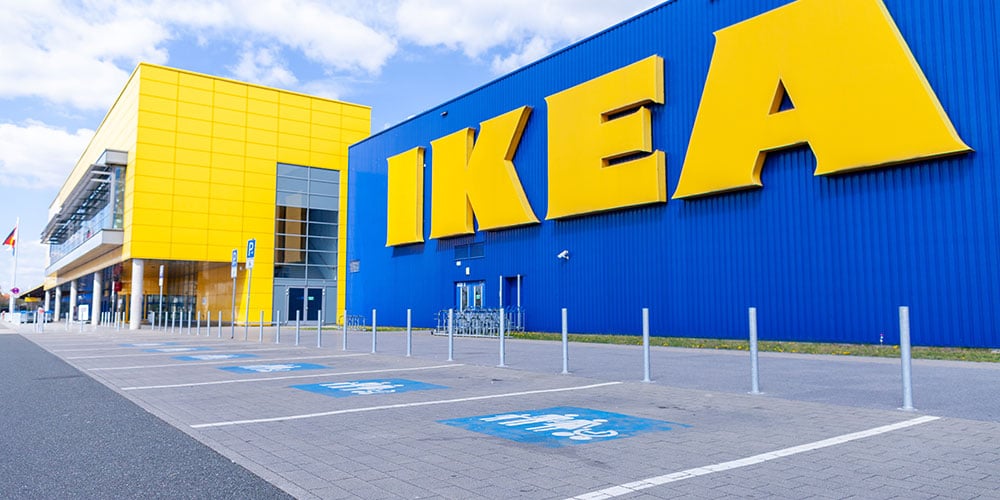

Have you ever found yourself captivated by IKEA, imagining the ideal home setup, and maybe spending more than planned to recreate the beauty you see in the aisles in your own living spaces?
As one of the world’s largest retailers, the Swedish giant has not only redefined home furnishing but has also set a standard that few can match regarding warehousing and distribution strategies. Join us as we uncover the secrets behind IKEA’s innovative strategies, integral to its success in delivering quality products to customers worldwide.
The IKEA Retail Phenomenon and its Warehousing Strategies
IKEA is celebrated for its focus on efficiency, sustainability, and innovation, with warehousing playing a pivotal role. Key aspects of IKEA’s warehousing success include:
IKEA’s Optimized Warehouse Design and Layout
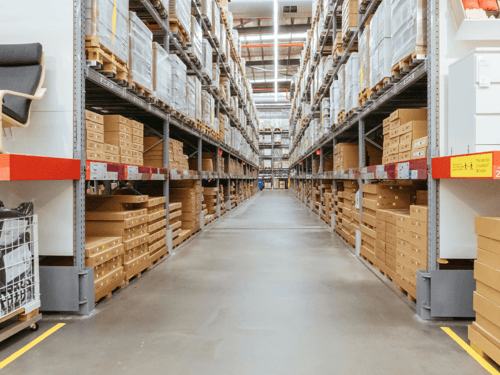
IKEA’s warehousing strategy focuses on its efficient warehouse layout, which is strategically designed to maximize space and minimize wasted storage. They use tall, narrow aisles and high-density storage systems to maximize storage efficiency, whether in traditional or automated warehouses. This layout allows more items to be stored in a smaller space, making it easy for employees to access them.
Also, IKEA strategically positions its warehouses to serve specific regions optimally. Using a hub-and-spoke model, IKEA has distribution centers as hubs and smaller regional warehouses as spokes. This structure helps the company improve transportation and inventory management, ensuring products reach stores quickly.

IKEA’s Automated Regional Distribution Centers
IKEA’s modern warehousing operations are all about automation. The company invested substantially in technology to enhance efficiency through automated warehouses.
IKEA uses Automated Storage and Retrieval Systems (AS/RS) to move products around without needing people to do it manually. Robots and conveyors do the heavy lifting, making the process faster and less prone to mistakes. Automation not only makes better use of storage space but also improves the accuracy of orders, making customers happier.
Flat-Pack Packaging: IKEA Space-Saving Warehousing Solution
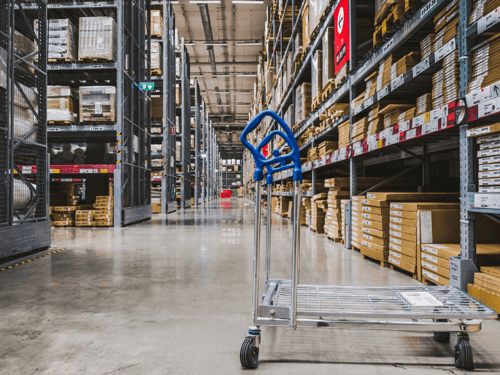
IKEA’s unique flat-packaging strategy boosts its distribution warehousing efficiency. The furniture is designed to be easily disassembled and packed flat, saving space in the warehouse. This compact design allows more items to be stored and shipped in a single shipment, reducing shipping costs, environmental impact, and the need for large warehousing space.
IKEA’s Cross-Docking Strategies for Streamlined Supply Chain
To accelerate the flow of goods through its supply chain, IKEA uses cross-docking. It involves unloading goods from incoming shipments and immediately loading them onto outgoing trucks with little to no storage time in between. By keeping inventory time short, IKEA delivers orders faster, cuts lead times, and enhances the overall supply chain efficiency.
Just-In-Time Inventory Management in IKEA Distribution Centers
IKEA is known for its “just-in-time” approach. This way, they save money on warehousing because products aren't stored for too long. It also reduces the chances of having unsold items, helping IKEA stay efficient and adapt quickly to market trends.
IKEA’s Warehouse Inventory Tracking and Management Tools
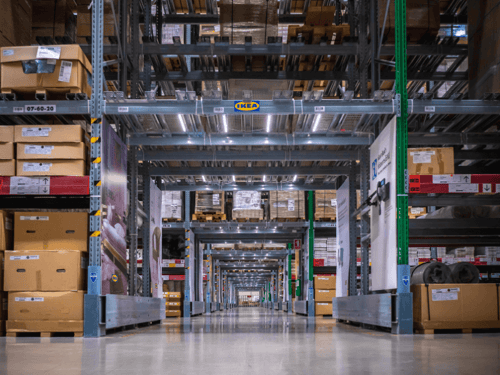
IKEA uses smart software to keep track of how much stuff is in all its warehouses. It helps the company be super efficient, avoid mistakes, and streamline its warehousing processes. The software is a powerful tool, making sure everything runs smoothly and customers are happy. By carefully monitoring stock levels and quickly identifying discrepancies, IKEA can use resources wisely, be more efficient, and reduce waste.
IKEA’s Supply Chain Collaboration with Suppliers
IKEA’s success in managing warehouses is greatly influenced by its strong partnership with suppliers. Instead of just viewing them as transactional partners, IKEA sees them as crucial collaborators. The company works closely with suppliers to plan production schedules and optimize shipping schedules to match its warehousing and distribution needs.
This teamwork ensures a smooth flow of goods, minimizing delays and keeping inventory levels optimized. This cooperative approach reflects IKEA’s commitment to efficiency and maintaining a well-coordinated supply chain. It strengthens ties with suppliers and establishes IKEA as a reliable and forward-thinking partner in the industry.

Sustainability and Environmental Considerations in IKEA Warehouses
IKEA places a strong emphasis on being eco-friendly and sustainable, even in the warehouses. IKEA warehouses use energy-saving lights, recycling programs, and sustainable methods. It reduces costs, aligns with what today’s shoppers like, and helps build a green image.

Safety Culture at IKEA Warehouses and Distribution Centers
IKEA, like many big retailers with large warehouses, prioritizes safety, including rack safety, within its warehouses.
Safety is a key aspect of IKEA’s operations, alongside its focus on sustainability and efficiency. Here are some safety measures IKEA typically follows in the warehouses:
- Employee Training: IKEA invests in comprehensive employee training programs, ensuring safety is a core aspect of their responsibilities. It includes proper rack usage, loading procedures, and safety protocols.
- Safety Protocols: Strict safety protocols are in place to mitigate risks and prevent accidents. Emphasis is always on the importance of safety, ensuring the safe handling and storage of products in the warehouse.
- Safety Equipment: IKEA provides essential safety equipment, such as guardrails, safety netting, and rack protection, to ensure a secure working environment.
- Employee Involvement: IKEA encourages employees to actively contribute to enhancing safety and taking ownership of their work environment. This empowerment fosters a culture of responsibility and safety awareness.
IKEA's Commitment to High Safety Standards
It’s important to highlight that IKEA’s commitment to safety aligns with the industry’s best practices for warehouse safety. Measures are taken to prevent accidents, protect employees, and maintain the structural integrity of the racking systems. While specific practices may vary by location, safety is a top priority for IKEA warehouses to ensure the well-being of their employees and the efficiency of their operations.

Lessons Learned from IKEA’s Warehousing Expertise
In summary, IKEA’s warehouse methods serve as a successful model for efficiency, sustainability, and innovation in today’s retail world. Through innovative warehouse design, technology use, and effective inventory management, IKEA remains a leader in the furniture industry. The company’s ongoing advancements in warehousing and supply chain strategies set an example for businesses looking to improve their storage and distribution processes.
IKEA’s approach, featuring optimized warehouse layouts, just-in-time inventory, flat-pack designs, automation, and a focus on sustainability and warehouse safety, sets a benchmark for the industry. While not every company can match IKEA’s scale, valuable lessons can be learned from these warehousing practices. As customers worldwide continue to turn to IKEA warehouses for furnishings, the company’s warehousing excellence remains a crucial aspect of its sustained success.
If your company is looking to enhance its warehouse safety, consider seeking professional rack safety assistance. Visit Damotech’s DAMO CARE Rack Safety Program to learn more.
Frequently Asked Questions
What solutions exist for integrating rack safety in just-in-time operations?

- Proactive Inspections: Implement frequent inspections to identify and address rack damage early, before it can escalate and impact your workflow.
- Rapid-Deployment Repairs: Utilize rapid-install repair solutions, such as DAMO PRO, to quickly fix damaged racking. This minimizes downtime and ensures your operations stay on schedule.
- Strategic Protection: Install durable protection products in high-traffic and high-impact zones. This prevents damage from occurring, reducing the need for emergency repairs.
- Centralized Management: Leverage the Damotech Platform for centralized tracking and management of your rack maintenance. This allows you to coordinate repairs and inspections efficiently without disrupting your JIT flow.
What actually makes IKEA’s warehouse network so efficient?
Three pillars show up repeatedly in public case studies: (1) centralized planning of suppliers, DCs, and stores; (2) aggressive use of automation (AS/RS, conveyors, store‑fulfillment automation); and (3) packaging designed for logistics (flat‑pack). These moves compress lead times, raise storage density, and improve order accuracy—benefits any DC can harness with the right change plan.
Does IKEA really use drones and AS/RS—or is that hype?
It’s real. Ingka Group has publicly documented the scaled use of autonomous inventory drones in stores and DCs, and reporting shows expansion to North American facilities. IKEA Components also runs pallet AS/RS with stacker cranes and WMS‑driven real‑time visibility. Takeaway for your site: automation that targets count accuracy and travel time can unlock both labor safety and throughput.
How does flat‑pack design translate into warehouse wins?
Flatter packs increase cube utilization in storage and transport, reduce handling damage, and lower touches. That means fewer replenishments, more pallets per lane, and better trailer fill rates—classic “design for logistics.”
What safety implications come with narrow aisles and more automation?
Higher density and machine movement raise exposure to rack strikes, pinch points, and mixed fleet traffic. OSHA’s warehouse guidance highlights forklift controls (speed, training, aisle clearance), guarding floor/wall openings, and clear materials‑storage practices—baseline controls to hard‑wire as you densify and automate. Add physical guarding in high‑impact zones (ends of aisles, tunnel bays, dock approaches) and keep operators trained.
How often should my racks be inspected if we’re increasing throughput?
Use a tiered cadence: daily/weekly in high‑velocity zones, monthly visual checks, and baseline plus annual third‑party engineering inspections—especially after reconfigurations or incidents. Prioritize findings by severity and document fixes; that’s how you stay ready for OSHA’s current focus on warehousing and distribution.
If we change beam levels to fit more SKUs, what load‑capacity rules apply?
Any beam move can change frame capacity and stability. Control it with up‑to‑date LARCs, engineering checks to current rack codes, and posted load plaques. As a rule of thumb, respect beam deflection limits (e.g., L/180) and height‑to‑depth stability ratios; when in doubt, have an engineer recalculate before you re‑slot.
Title Inside of Accordion Goes Here
Prioritize: (1) end‑of‑aisle frames and tunnel bays; (2) upright bases at intersections and pick‑faces; (3) building columns and critical infrastructure; (4) dock‑adjacent frames. Pair physical protection with driver training and clear travel paths. This aligns with proven prevention steps in a mature rack‑safety program.
If we adopt drones or AMRs, what should change in our SOPs?
Update your traffic plans, fall‑protection and exclusion‑zone rules, maintenance lockout/tagout, and incident‑response procedures; confirm that autonomous operations don’t compromise forklift sightlines or rack clearances. Keep forklift and pedestrian safeguards from OSHA’s warehousing series front‑and‑center while layering in OEM safety guidance for the new tech.