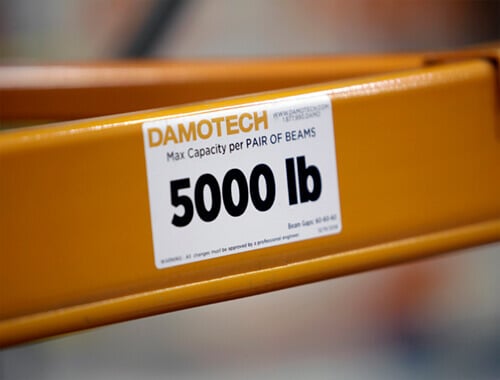
Knowing and displaying your pallet rack load capacities is critical to the safe operation of your warehouse — and required under North American building codes. Yet many facilities lack their original rack design drawings (LARCs), leaving forklift operators without accurate, verified beam capacity ratings. Any modification to a rack system — adding, removing, or replacing a beam, or adjusting beam height — requires a full recalculation of the load capacity for every affected beam pair. Damotech's professional engineers determine the maximum load capacity of any rack system using code-compliant structural calculations, then produce all required capacity labels and plaques for proper display.

Damotech's professional engineers begin by collecting precise on-site measurements of your racking systems — uprights, beams, connectors, and configurations. Using code-compliant structural engineering calculation models that account for all required loads, including seismic forces, they calculate the maximum load capacity for each upright-beam pair. The process concludes with a stamped engineering report and certified beam-capacity labels or plaques identifying the allowable load for each rack position. The entire process is non-disruptive to your warehouse operations.
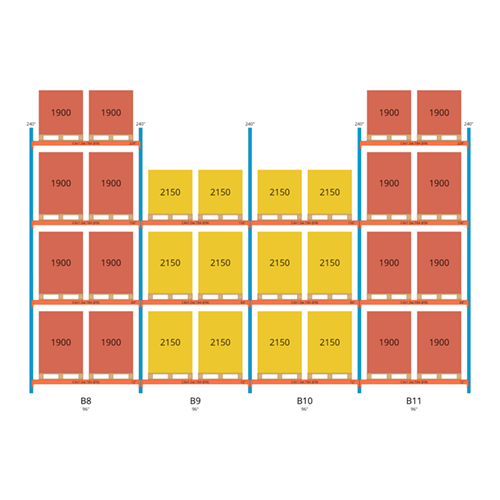
Damotech's engineers deliver a complete pallet rack load capacity report containing detailed drawings and the certified load capacity for every rack position and beam level. Each report includes:
Labels are typically affixed to the first beam at eye level to accommodate varying capacities throughout a system, while load plaques (per ANSI MH16.1) are best suited for rack systems with uniform capacity, displayed at aisle entrances for forklift operator visibility.



Yes. Damotech always provides engineer-stamped load capacities prepared and sealed by a licensed Professional Engineer. An engineer-stamped report formally certifies that your specific rack configuration has been structurally analyzed and complies with applicable building codes and industry standards.
While the engineer-stamped report includes the certified allowable load capacities and engineering conclusions, it does not include the full mathematical calculation derivations or proprietary engineering models (stamped calcs). Our engineer-stamped documents provide the validated results and compliance confirmation necessary for regulatory, insurance, and operational purposes.
Engineer-stamped capacities are typically required for rack modifications, height changes, seismic compliance, insurance documentation, or when requested by local authorities.
While storage rack regulations may not explicitly mandate the inclusion of capacity ratings, OSHA may invoke the General Duty Clause, especially in cases of rack collapse due to overloading. Even in the absence of a collapse, racks exhibiting signs of sagging or other indications of overloading pose potential safety hazards.
OSHA, in justifying a General Duty Clause citation, may reference recommendations from the rack manufacturer or adhere to ANSI/MH 16.1 standards. These references empower OSHA to demonstrate that the installation of a load rating sign could help mitigate recognized hazards and enhance overall safety in the workplace.
Learn more about ANSI/MH 16.1, Design, Testing, And Utilization Of Industrial Steel Storage Racks.
Yes, it's possible if the chart is signed by an engineer for your specific site. General load capacity charts published by the OEM cannot take into account seismic effects. Therefore, a chart must be calculated for your specific rack configurations and location.
No, capacity labels are not necessary on all beam levels. The American and Canadian building codes refer to the rack design standards that indicate that individual beam load capacity weights must be displayed on rack systems. Neither code imposes a method for communicating load capacities, but labels on each bay or load capacity plaques at the end of aisles are most common.
There are several ways to communicate the load capacity of a racking system. We suggest placing labels on the first beam elevation, ideally near eye level, since it allows for varying weight load capacity throughout a rack system. When the racks are uniformly designed, rack load capacity plaques can be displayed at the end of aisles and in tunnels.
Did you know that a change in a beam elevation will most likely affect the load capacity of other beams (even in neighboring bays)? Therefore, in most jurisdictions in North America, any change to a rack must be reviewed by a racking specialist before being put into service again. That is because some seemingly minor changes may negatively impact the racking system's load-bearing performance. Adding, removing, or replacing a beam with different specs may also affect the load-bearing capacity of your entire racking system.
There are no regions that are not seismic. It’s just that some regions experience so very small tremors that other load effects control the design of the racking system. If your warehouse is located in a high seismic zone like the east and west coasts of North America (U.S. and Canada) or near Memphis, you have more reasons to maintain the safety (and structural integrity) of your racks as the horizontal movement during a seismic event will generate substantially more loads on your rack systems than in other regions.
LARC stands for Load Application and Rack Configuration. These are stamped engineering drawings (often referred to as CAD drawings) of the rack systems in your warehouse. Typically, the OEM (original equipment manufacturer) provides these when installing the new racking systems. If racks are reconfigured after the initial installation, new LARCs with weight capacities must be produced by an engineer. Learn more about LARCs in this article.
A PSR stands for Pre-Start Health and Safety Review. In some jurisdictions in North America, such as Ontario, any modification to a pallet rack system must be reviewed by a knowledgeable rack expert before it is put back into use. Learn more about PSR on this page.
Be careful using those, and read the small characters at the bottom of the chart. They indicate that the chart does not take into account all possible loads like seismic forces and that all components must be compatible and come from the same manufacturer.
Also, to respect the building and OSHA codes, a professional engineer must certify the racks for load capacity.
It’s not that we want to skirt around the subject of pricing. We like to know what things cost, too.
We tailor our weight capacity calculation services to our customers' needs anywhere in the United States or Canada. Consequently, our pricing factors geographic location, warehouse size, racking type and environment (freezers, cold storage, exterior, ...), to offer a detailed quote and avoid any surprises.
To get more information on pricing; request a free quote or call 1 (877) 990-3266 and let us demonstrate the value of our engineering services.

Contact one of our experts to learn more about our rack load calculation services.