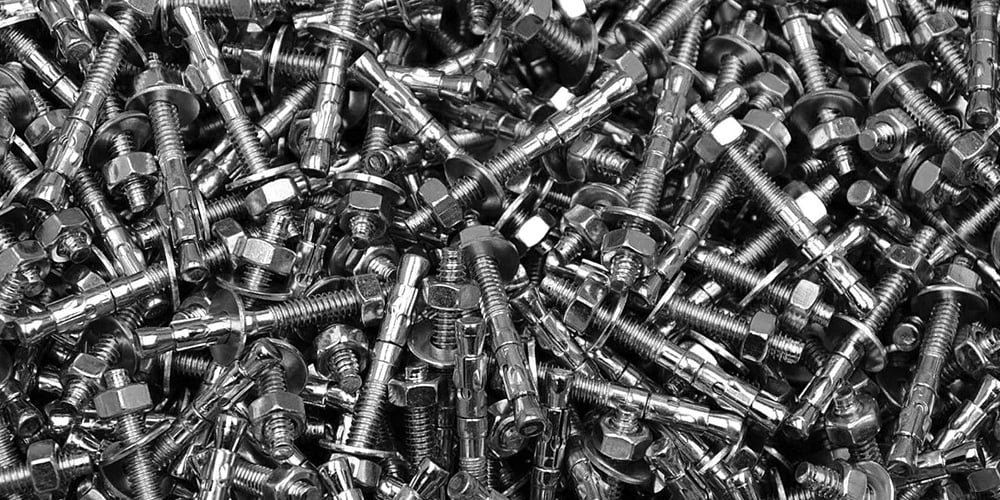

When it comes to warehouse safety and rack stability, pallet rack anchors play a critical role—and their importance is often underestimated. According to ANSI/RMI standards, every upright column in a storage rack system must be properly anchored. But why is that such a big deal?
In this blog, we’ll break down why pallet rack anchors matter, what types are commonly used, how to choose the right size, and what standards you need to follow. Whether you're installing a new system or inspecting an existing one, understanding these anchoring fundamentals is key to keeping your warehouse safe and compliant.
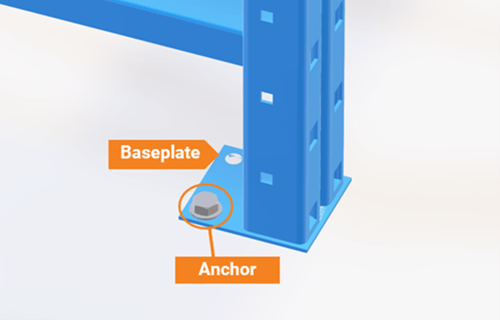
Figure 1: A close-up view of a rack baseplate, a pallet rack anchor, and an empty anchor hole.
Why are pallet rack anchors essential to the racking system?
While often incorrectly referred to as anchor bolts, pallet rack anchors are mechanical fasteners used to connect a rack system to the building floor. Their purpose is to secure pallet racks and resist constant antagonizing forces, including:
- Overturning forces caused by earthquakes, winds, and narrow/tall racks.
- Accidental impact forces at the base of columns (e.g., from forklifts).
- Shear forces (horizontal reactions) that reduce the rack’s bearing capacity.
Should the pallet rack anchor fail to withstand these destabilizing forces, the consequences could include large bending forces on the upright, affecting the overall stability of the system and, in the worst case, leading to a collapse. To avoid this, it’s key to select the right pallet rack anchor type based on the facility’s different conditions and the rack type.
What common types of pallet rack anchors can be found in a warehouse?
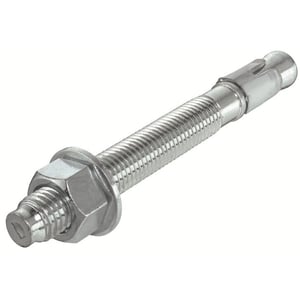
Wedge Anchors, a popular type of anchor, are manufactured from carbon steel, hot-dipped galvanized steel, stainless steel, or zinc-plated steel. These fasteners are mostly used in solid concrete and cannot be removed if you decide to rearrange your pallet racks, because they will damage your floor.
Concrete Strike Anchors are impact-expansion form anchors also used in solid concrete. Given their mechanical properties, they should not be installed in any other type of masonry material.
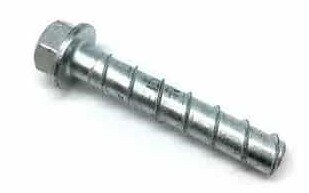 Screw Pallet Rack Anchors are a much less common type of fastener found in warehouses. They are used for temporary or permanent anchoring, as they can be removed and installed in both concrete and masonry.
Sleeve Pallet Rack Anchors are ideal for light- to medium-duty anchoring in concrete and masonry. No matter the type of anchor you choose, all can be found in a variety of diameters, lengths, and thread lengths.

What size of pallet rack anchor is adequate?
A rule of thumb is that the broader the diameter and the deeper the embedment, the greater the anchor's strength. So, it’s important to check local building codes or have an engineer determine the bolt sizes, given that several factors need to be considered: the hole size of the upright’s baseplate, seismic activity, and the area where the anchor is to be used.
Additionally, the thickness of the flooring material, its mechanical properties, and the floor level should be considered in case shims are needed.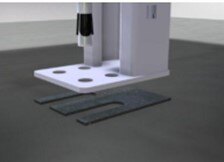
Figure 2: A shim placed under a pallet rack column.
How many anchors does each pallet rack baseplate need?
The ANSI/RMI standards require a pallet rack anchor, which states that all rack columns should be anchored with at least one anchor per upright column. Depending on the type of pallet rack anchor, two anchors can be installed to prevent the column from pivoting upon impact.
In situations where the user cannot correctly anchor the rack, it is recommended to verify with the rack manufacturer’s engineers for alternative anchoring methods that keep the structure safe for use.
Should loose racking anchors be tightened?
Anchors for pallet racking must be properly tightened to the manufacturer's minimum recommended torque. For 3/8" pallet rack anchors, this is typically 40 ft-lb. Inadequate tightening can make the pallet rack anchor ineffective.
Why Damotech Uses Screw-Type Concrete Anchors for its Repair and Protection products
At Damotech, every component we specify is selected to maximize structural reliability, long-term safety, and real-world performance in active warehouse environments. This includes our choice of Hilti screw-type concrete anchors instead of traditional wedge-type expansion anchors.
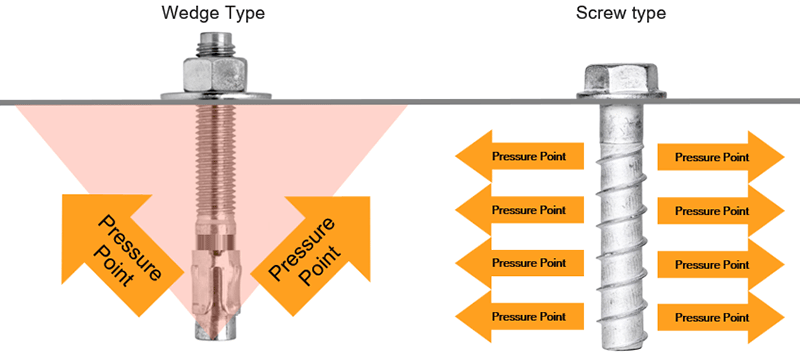
The difference is not cosmetic—it’s mechanical.
1. Load Transfer That Works With the Concrete, Not Against It
Screw-type anchors engage concrete through a continuous helical thread cut directly into the slab. This creates:
- Distributed load transfer along the full embedment depth
- Multiple contact points instead of isolated pressure zones
- Lower localized stress concentrations
By contrast, wedge anchors rely on radial expansion at a single point, creating intense outward pressure that can:
- Micro-fracture concrete
- Form stress “craters” around the anchor
- Reduce long-term holding capacity, especially in aging or thinner slabs
Result: screw anchors preserve slab integrity while maintaining predictable load performance.
2. Tightening Increases Holding Power—Not the Risk of Failure
A key mechanical advantage of screw-type anchors is load directionality:
- Tightening a screw anchor pulls it into the concrete
- This increases thread engagement and friction
- More concrete contributes to resisting pull-out forces
With wedge anchors, tightening:
- Pulls the anchor upward
- Relies entirely on outward expansion
- Can reduce effective embedment and weaken the surrounding concrete over time
Result: screw anchors get stronger when properly tightened; wedge anchors become more failure-prone.
3. Superior Resistance to Vibration and Cyclic Loads
Warehouse racking is exposed to:
- Forklift impacts
- Pallet loading cycles
- Floor vibration from constant traffic
Screw-type anchors provide mechanical interlock, not friction-only resistance. This makes them:
- Far less prone to loosening over time
- More stable under vibration
- Better suited for dynamic, high-traffic industrial environments
Wedge anchors, by comparison, are inherently more susceptible to loosening as micro-movement degrades the expansion grip.
4. Controlled Installation, Inspection, and Re-Torque Capability
Hilti screw anchors allow:
- Precise torque control
- Visual inspection of seating
- Verification without destructive testing
They can also be:
- Removed and replaced if required
- Installed closer to slab edges without inducing cracks
- Used in a wider range of concrete conditions
This aligns with Damotech’s engineered-repair philosophy: every solution must be inspectable, verifiable, and defensible.
5. Alignment With Engineering Standards and Liability Protection
Damotech designs and installs solutions in compliance with:
- RMI and CSA rack safety standards
- Manufacturer-validated anchor performance data
- Engineering best practices for cracked and uncracked concrete
Hilti screw anchors provide:
- Published load ratings
- More Consistent performance across slab conditions
- Documentation suitable for engineering reports and audits
Result: safer installations and stronger legal defensibility for facility owners.
Why This Matters for Rack Safety
Rack anchoring is not a commodity decision.
It is a structural interface between steel systems and concrete slabs—and failures almost always originate there.
By specifying Hilti screw-type anchors, Damotech ensures:
- Higher long-term holding capacity
- Reduced concrete degradation
- Better performance under real warehouse conditions
- Anchoring systems that match the durability of engineered rack repairs
This is why Damotech does not treat anchors as interchangeable hardware—but as critical structural components.
Final Thoughts: Don’t overlook pallet rack anchors
Pallet rack anchors are an essential part of any racking system, directly impacting its support and overall stability. Every detail matters, from selecting the right anchor type and size to ensuring proper quantity and torque. Overlooking any of these factors can compromise safety and performance.
At Damotech, all our products are delivered and installed using Hilti screw-type anchors, known for their high shear capacity, ease of removal, and ease of installation. Unlike expanding wedge or sleeve anchors, they minimize damage to concrete while providing reliable, long-lasting anchoring.

FAQ About Pallet Rack Anchors
Do pallet racks need to be anchored to the floor?

Yes. For industrial steel storage racks designed in accordance with ANSI MH16.1, all rack columns must be anchored to the concrete floor slab as specified in the approved design and installation documents. The required anchor type, diameter, embedment depth, quantity, spacing, placement, and installation torque depend on the rack design, concrete slab, anchor system, and site conditions. Follow the engineered rack drawings and the anchor manufacturer’s installation instructions. Consult a qualified rack engineer whenever the drawings are unavailable, the rack has been reconfigured, or damaged or missing anchors need to be replaced.
How many anchors are required per pallet rack base plate, and does their placement matter?
There is no universal rule that every pallet rack base plate requires exactly one or two anchors. The rack design engineer determines the required anchor type, diameter, embedment depth, quantity, and placement based on the rack configuration, concrete slab, seismic conditions, and other design forces. These requirements should be shown in the approved rack design and installation documents.
Baseplates frequently contain more holes than the design requires, so not every hole should necessarily receive an anchor. One anchor may be specified for certain rear columns, while two or more may be required for aisle-facing columns, shimmed base plates, seismic areas, taller rack systems, or other design conditions. When multiple anchors are required, install them in the locations shown on the drawings rather than choosing side-by-side or diagonal placement based on a general rule.
If the drawings are unavailable, the rack has been reconfigured, or the anchorage needs to be changed, consult the original rack manufacturer or a qualified rack engineer before proceeding.
RMI’s current guidance supports this approach: the engineer specifies the number, size, depth, and placement of anchors; base plates often include extra holes; and not every hole necessarily requires an anchor. RMI also identifies conditions in which one, two, or more anchors may be appropriate.