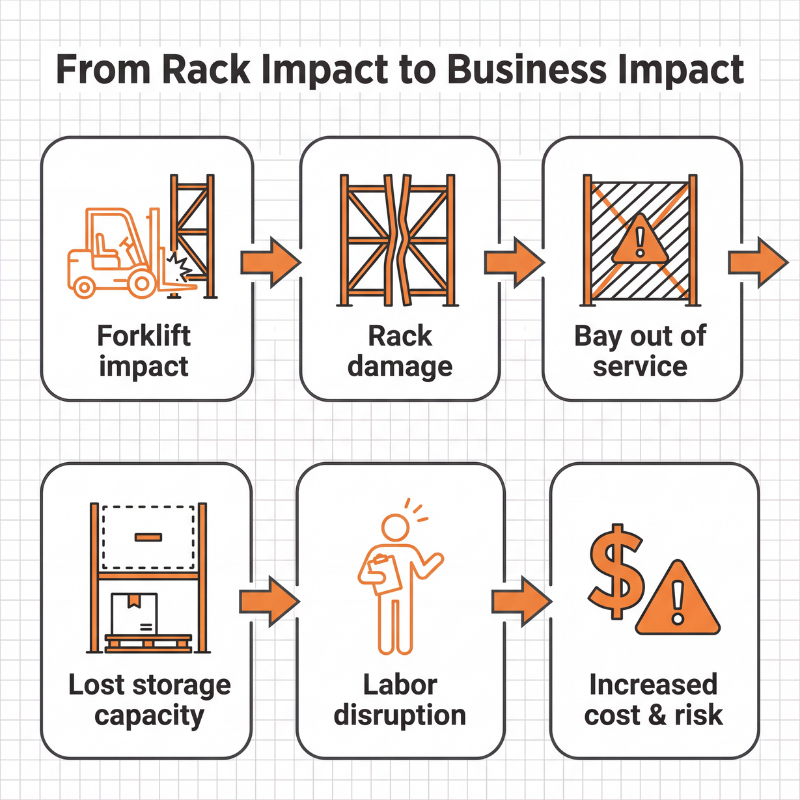
A forklift clips an upright. Now a bay may be out of service. Pallets may need to be moved. Traffic may get rerouted. Maintenance has to decide what happens next.
What starts as a single impact can quickly affect storage availability, aisle flow, labor efficiency, and floor safety.
Rack safety is no longer just a maintenance issue. In today’s warehouse environment, it directly affects uptime, cost control, compliance, and operational risk across single facilities and multi-site networks.
For years, many teams treated rack damage as a local fix: a column got hit, a repair was scheduled, and the warehouse moved on. That approach is harder to defend today. Damage doesn’t stay isolated—it can reduce usable storage, disrupt aisle flow, create documentation gaps, and pull safety, operations, engineering, procurement, and finance into the same problem.
“Racks are highly efficient structures that require all components to be free from damage to fully bear the loads,” explains Charles Carbonneau, Chief Engineer at Damotech. “When that condition is compromised, the impact goes beyond the structure itself—it affects how the entire warehouse operates.”
That is the shift warehouse leaders need to recognize. Damage may be common, but unmanaged damage creates operational, financial, and compliance consequences.
Why Has Rack Safety Become a Business Decision?
Rack safety now affects more than maintenance budgets. It influences throughput, liability exposure, capital planning, and site-level execution.
When a rack component is damaged, the problem does not stay contained to the steel.
- A bay may need to be unloaded.
- Forklift traffic may have to be rerouted.
- Picking paths may become less efficient.
- Storage positions may be lost until corrective action is taken.
In a busy warehouse, that kind of interruption can quickly become an operations problem, not just a repair problem.
For companies with multiple facilities, the stakes are even higher. One site operating with weak follow-up, missing records, or recurring impact zones can create avoidable costs and unnecessary exposure across the network.
That broader business impact is why rack safety decisions often extend beyond maintenance and affect multiple teams across the business.

How Rack Safety Affects Different Teams
The same rack issue rarely affects just one team. It creates different challenges across operations, maintenance, safety, engineering, and leadership.
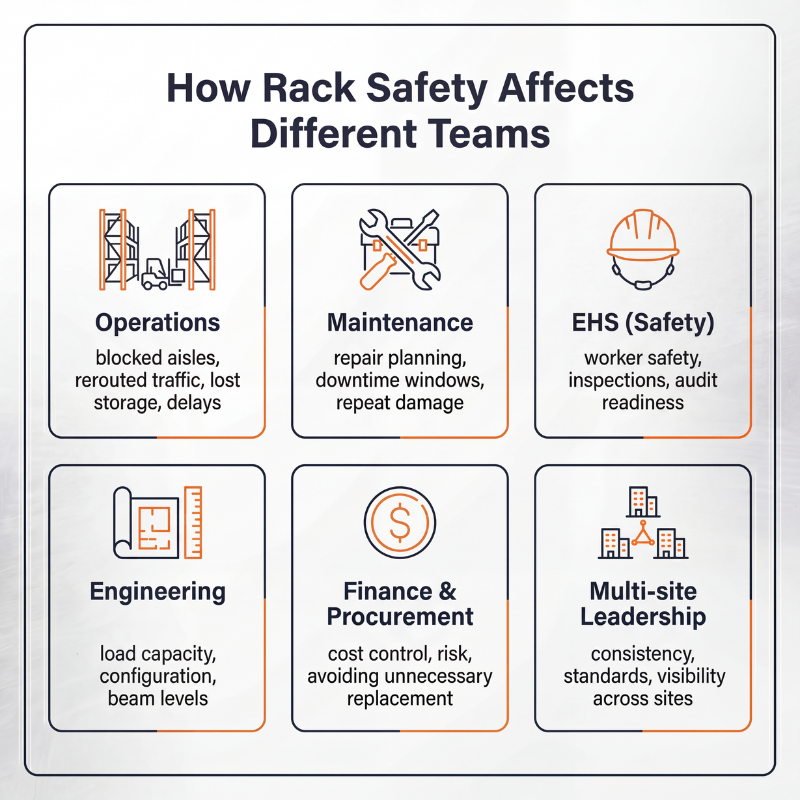
- Operations: disruptions on the floor, including blocked aisles, rerouted traffic, and reduced storage availability
- Maintenance: unplanned repairs, scheduling challenges, and repeated impacts in the same locations
- EHS: increased safety risk, inspection requirements, and pressure to maintain audit-ready documentation
- Engineering: questions around load capacity, configuration changes, and structural integrity
- Finance & Procurement: cost control, risk exposure, and avoiding unnecessary replacement spending
- Multi-site leadership: maintaining consistent standards and visibility across facilities
This is why rack safety decisions rarely stay within maintenance. The same issue can affect throughput, safety, compliance, and cost at the same time.
What Does Reactive Rack Maintenance Really Cost?
Reactive rack maintenance costs more than the repair itself. The hidden cost often shows up in blocked storage, unplanned labor, recurring damage, emergency purchasing, and weak documentation.
Most warehouses do not ignore rack damage. The problem is that many handle it one incident at a time:
- A damaged upright gets flagged.
- A bay gets unloaded.
- A replacement or repair is arranged.
- Work is scheduled around production.
- Then the same location gets hit again a few months later.
A common example is a high-traffic end-of-aisle location. The damaged upright gets fixed, but the area is never protected, the traffic pattern never changes, and the same spot gets hit again. The business pays for the issue multiple times without actually reducing the risk.
That is where a reactive approach starts to fail.
| Reactive | Proactive |
|---|---|
| Repeat damage | Root cause addressed |
| Emergency fixes | Planned repairs |
| Inconsistent approach | Standardized process |
| Higher long-term cost | Controlled long-term cost |
Without a structured process for inspection, prioritization, corrective action, and prevention, the same issue can keep recurring under different work orders and budgets. This is the logic behind Damotech’s integrated rack safety approach: reduce repeat damage instead of simply responding to the next incident.
In one case study, a national retailer cut spending on rack component replacement by more than 70 percent after implementing a standardized methodology and inspections across the network.
How Much Downtime Can Damaged Racking Create?
Even localized rack damage can affect multiple storage positions. It can change how people and lift trucks move through the warehouse, slow picking, and reduce throughput.
Consider one damaged upright in a critical aisle:
- The bay may need to be taken out of service.
- Operators may have to change routes.
- Pickers may need longer travel paths.
- Supervisors may have to reassign labor or adjust workflow.
What starts as one structural issue can quickly affect shift efficiency.
That matters even more in high-throughput environments, where even minor interruptions can ripple into missed productivity targets or service delays. And in multi-site operations, lost capacity in one building can put additional pressure on nearby facilities. The point is not only to fix the damage quickly, but also to reduce the chance that the same disruption occurs at the same location again.

Should Every Damaged Rack Component Be Replaced?
No. Blanket replacement increases cost and disruption. The smarter approach is to determine, with engineering, when repair is safe and when replacement is actually necessary.
Replacement is sometimes the right answer. But not every damaged rack component needs to be replaced automatically.
A repair-first mindset helps teams reserve replacement for the cases where it is truly required. That matters because unnecessary replacement can increase material costs, prolong disruption, and keep teams stuck in a cycle of repeated damage and spending.
The better question is not, “How fast can we replace this?” It is, “What is the safest, most operationally sound, and most cost-effective corrective action here?”
That distinction matters because replacement often requires unloading, dismantling, and longer lead times, while engineered repair can often reduce disruption and preserve load capacity when the situation allows.
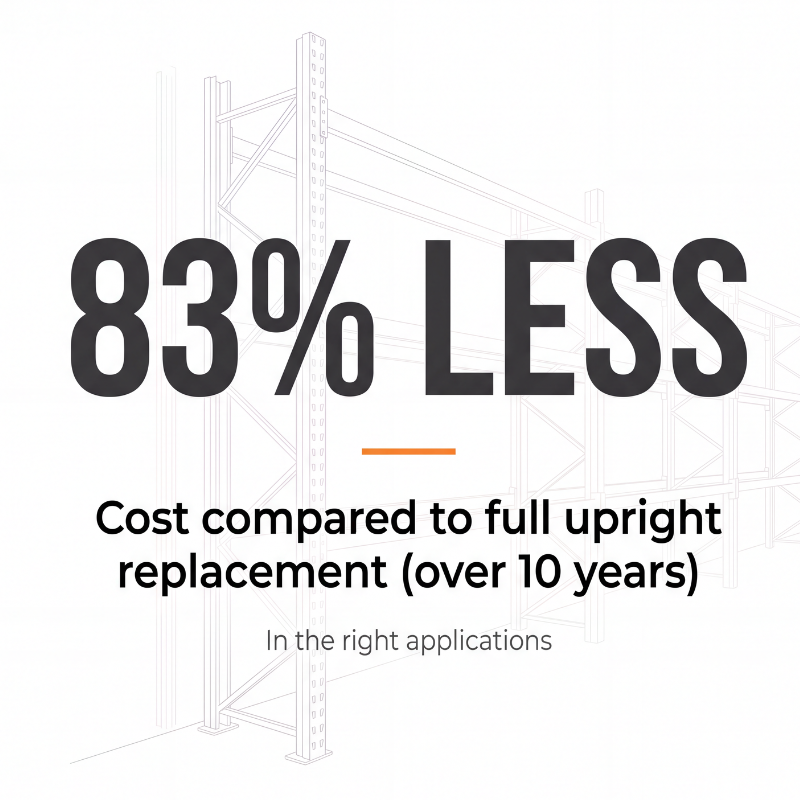
Engineered repair can cost up to 83 percent less than full upright replacement over a 10-year period in the right applications.
What Does a Lifecycle Rack Safety Program Look Like?
A strong rack safety program does more than fix isolated damage. It connects inspection, engineering, repair, protection, training, and tracking into one repeatable process.
A lifecycle approach typically includes:
- inspections to identify damage, deficiencies, and risk areas
- engineering review and load capacity validation
- repair solutions for viable components
- protection for repeat-impact zones
- employee awareness and training
- tracking tools to document priorities, actions, and history over time
That is a stronger model than treating inspections, repairs, protection, and follow-up as separate tasks managed in different silos. It gives teams a way to reduce recurring damage instead of simply reacting to the next impact.
Rack collapse is rarely caused by a single event. It is usually the result of a chain of issues that were not identified or addressed early enough. That is why a rack safety program should be put in place to interrupt the chain early, before small issues become expensive ones.
How Do You Reduce Compliance and Liability Risk Across Multiple Warehouses?
The real risk is not only the damaged rack itself. The real risk is inconsistency:
- One site may catch issues early.
- Another may rely on informal judgment.
- A third may repair damage without a clear documentation trail.
That kind of variation creates exposure, especially for companies responsible for several facilities.
A stronger program applies the same logic everywhere: the same inspection criteria, severity thresholds, and expectations for documentation and corrective action. That makes it easier to prioritize the highest-risk issues, prove that action was taken, and show that rack safety is being managed as a program rather than a series of isolated decisions.
Documentation is central to that effort. If load capacities are not clearly displayed or if configuration records are outdated, it becomes harder to show that the system is being used and maintained appropriately. As Carbonneau notes, companies are expected to keep stamped engineering drawings for the warehouse, and those records should match current conditions and stay up to date.
What Do Operations, Safety, and Finance Leaders Gain from a Proactive Approach?
A proactive rack safety strategy reduces disruption, improves capital planning, strengthens compliance, and cuts waste by treating racking as a managed asset.
Operations leaders experience less disruption. Better-planned corrective action helps keep aisles productive and reduces the drag created by repeated rack damage.
Safety leaders gain stronger documentation and a more defensible process. Engineer-led assessments, standardized damage classification, and tracked corrective actions make it easier to show due diligence.
Finance leaders gain better control over capital and maintenance spending. A repair-first strategy helps prevent unnecessary replacement and supports better long-term planning.
Sustainability-minded teams gain another benefit. When repair is viable, extending the useful life of existing racking can reduce steel waste and avoid unnecessary replacement.
In one case study, a national retailer improved safety while cutting replacement spending and making protected locations 10 times less likely to be replaced due to damage.
Can Rack Safety Support Sustainability Goals?
Repairing viable rack components can reduce steel waste, avoid unnecessary replacement, and support more resource-efficient warehouse operations across large networks.
Sustainability is usually not the first reason a warehouse team invests in rack safety, but it is a meaningful benefit of a smarter program. When a damaged rack component can be safely repaired instead of fully replaced, the business can avoid unnecessary material use, transportation, and disposal.
Just as important, the sustainability case does not compete with the financial case. In many cases, the same decision supports both. A smarter rack safety strategy can reduce waste while helping preserve capital and extend asset life. That makes the investment easier to justify internally, especially when operations, procurement, and leadership teams need alignment around long-term priorities.
What Questions Should Warehouse Leaders Be Asking Right Now?
The right questions can uncover avoidable replacement spend, inconsistent standards, repeat-impact areas, and gaps in training, documentation, and visibility.
If you oversee warehouse operations, facilities, safety, engineering, procurement, or capital planning, these are the questions worth asking:
- Are we replacing rack components that could be safely repaired?
- Do we know the real downtime cost of rack damage in each facility?
- Which locations create the most repeat damage and operational disruption?
- Are recurring impact areas being protected, or are we repairing the same spots again and again?
- Can we show consistent inspection criteria and repair documentation across our network?
- Do our teams know how to recognize and report rack damage quickly?
- Are we tracking deficiencies, repairs, and priorities across multiple sites consistently?
- Can our current approach support both day-to-day operations and long-term capital planning?
These are not just maintenance questions. They are business questions because they affect throughput, cost, worker safety, and the useful life of warehouse infrastructure.

What Should Warehouse Leaders Do Next?
Warehouse leaders should assess rack condition, standardize decision-making, prioritize repairs and protection, and track progress consistently across all facilities over time.
The companies that get the most value from their racking systems do not treat rack damage as a recurring nuisance. They treat rack safety as an ongoing business process.
That means systematically inspecting, making engineering-backed decisions, repairing what can be repaired, protecting high-risk areas, training employees, and tracking issues across the facility or network.
Damotech supports that broader approach through inspections, engineering, repair, protection, training, and software that help warehouse leaders connect findings to action and action to long-term control. That integrated model reflects how rack safety can be managed as a connected process, rather than a series of isolated decisions.
If your team is looking to reduce repeat damage, improve visibility, and make better decisions across facilities, now is a good time to move from reactive fixes to a more structured rack safety program. Talk to a rack safety expert to assess your current conditions and identify where a more structured program can reduce risk and cost.
FAQ: Rack Repair, Replacement, Downtime, and Compliance
Why is pallet rack safety a business decision?

Pallet rack safety is a business decision because damaged racking can affect uptime, throughput, capital planning, compliance, and overall operational risk within a single warehouse or across an entire facility network.
What does reactive pallet rack maintenance really cost?
Reactive pallet rack maintenance costs more than the repair itself. It can create downtime, labor disruption, recurring damage, rushed spending, and weaker documentation when teams need to show what was found, prioritized, and corrected.
How much downtime can damaged pallet racking cause?
Even localized pallet rack damage can disrupt forklift traffic, picking efficiency, labor flow, and order fulfillment. In multi-site operations, a disruption at one facility can also put pressure on nearby warehouses.
Should every damaged pallet rack component be replaced?
What does a pallet rack safety program look like?
How do you reduce pallet rack compliance and liability risk across multiple warehouses?
The strongest way to reduce pallet rack compliance and liability risk is through consistency. That means using the same inspection criteria, severity thresholds, documentation practices, engineering review, and corrective action process across every site.
Can pallet rack repair support warehouse sustainability goals?
Yes. When viable rack components are repaired instead of replaced, companies can reduce steel waste, avoid unnecessary material use, and extend the life of existing warehouse infrastructure.
What should warehouse leaders do next about rack safety?