
Rack Safety Governance for Multi-Site Operations
One standard. One workflow. One defensible view of risk—across every warehouse.
Rack safety governance is the standardized system of policies, inspections, engineering decisions, and reporting used to control pallet rack risk across multiple warehouses.

For Operations, Health & Safety, and Facilities Leaders Managing Multiple Sites
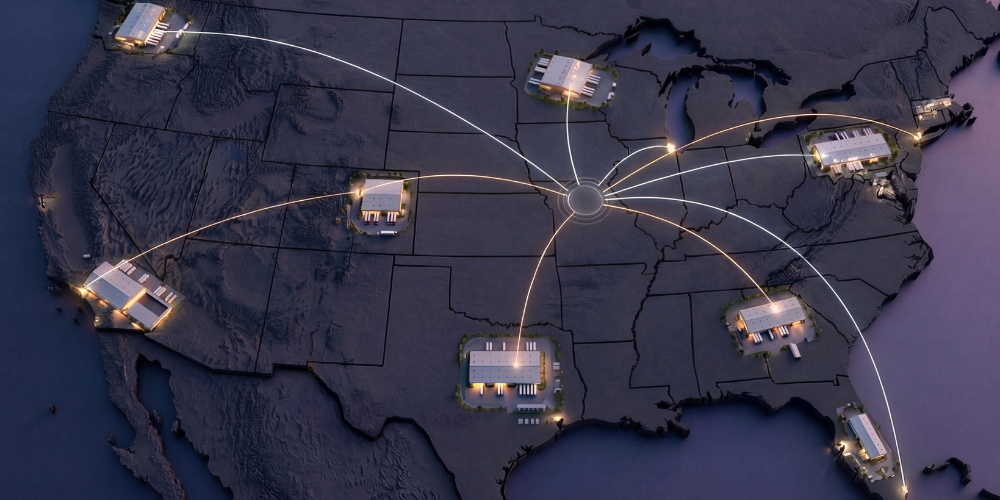
In a single warehouse, rack safety is usually manageable. In a network of 10, 50, or 200 facilities, rack safety stops being a maintenance task—it becomes a governance risk that can lead to downtime, injuries, and unplanned capital spend.
In multi-site networks, rack risk rarely comes from steel failure. It comes from inconsistent decisions.
One site repairs.
One isolates.
One defers.
Leadership sees cost, but not the pattern driving it. Until a preventable issue becomes operational downtime, emergency spend, or audit exposure.
Rack safety governance aligns standards, ownership, engineering decisions, and reporting across every facility before risk escalates.
What Happens Without Governance?
When the “rules” change by site, risk spreads quietly.
- Critical findings stay open too long
- Engineering decisions vary by facility
- Repair costs spike unpredictably
- Documentation gaps surface during audits
- Leadership reacts instead of controls
Rack Safety: With vs. Without Governance
| Without Governance | With Governance |
|---|---|
|
Inconsistent decisions across sites
|
Standardized actions and responses
|
|
Delayed or missed repairs
|
Defined timelines with clear ownership
|
|
No centralized visibility
|
Network-wide dashboard and reporting
|
|
Unpredictable maintenance costs
|
Controlled, forecastable spend
|
|
Audit gaps and compliance risk
|
Documented, defensible compliance
|
Jump to
What Governance Delivers
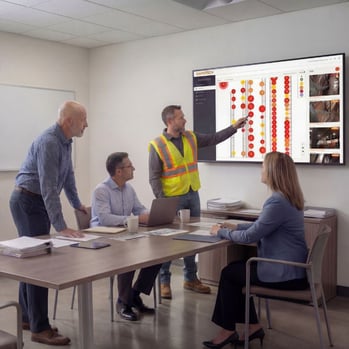
Governance turns rack safety from a reactive site-level effort into controlled enterprise risk management. At the network level, risk becomes measurable, controllable, and defensible.
| With Governance, You Gain |
|---|
|
One network view in a consistent format
|
|
Faster closure of critical issues with clear owners and due dates
|
|
Fewer repeat impacts through standardized engineered repair and protection
|
|
Stronger audit and insurer responses, with documentation easy to retrieve
|
The 5 Decisions Every Network Must Standardize
Multi-site rack safety becomes manageable when you standardize the following five decisions.
1. What counts as damage: A shared red/yellow/green model and what each status triggers.
2. Who owns closure: Clear accountability from detection → triage → approval → repair → proof.
3. How often racks are checked: Tiered inspections tied to action, not just observation.
4. What repairs are permitted (and when engineering is triggered): No improvisation. No ad hoc fixes. Clear escalation rules.
5. What leadership reviews monthly: KPIs that drive action, not reporting theatre.
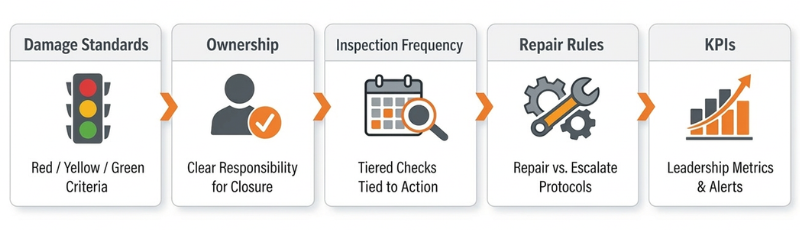
Standardizing these five decisions eliminates variability and turns rack safety into a controlled, network-wide system.
What Rack Safety Governance Is
Governance is the operating system behind your rack safety program.
It makes decisions repeatable across every facility.
A simple model:
Policy (Rules) → Process (Steps) → Evidence (Proof) → Review (Improve)
Inspections find issues.
Governance ensures issues are closed, documented, and prevented from repeating.
What Governance Looks Like in Practice
A national retail chain adopted a repair-first, standardized governance model across its network.
They reported:
- Nearly $10M per year saved on racking maintenance and replacement
- Approximately 70% reduction in annual racking spend per location in year one
- Approximately 91% reduction over two years
When decisions become consistent, financial outcomes compound.
Discover how a national warehouse network eliminated millions in unnecessary rack maintenance costs—and see how you can apply the same approach across your facilities. View Case Study.
Why Governance Breaks Down at Scale
Even well-run networks drift over time. Acquisitions, leadership turnover, vendor changes, layout modifications, and capital constraints introduce inconsistency.
- The steel outlasts the org chart.
- You inherit different rack brands, layouts, and ages.
- You inherit different habits.
Common symptoms:
- Inspections vary by site and shift
- Repairs vary by vendor (and paperwork varies too)
- Reports don’t roll up cleanly for leadership
- Changes happen without updated records
That’s not a maintenance problem. That’s a governance gap.
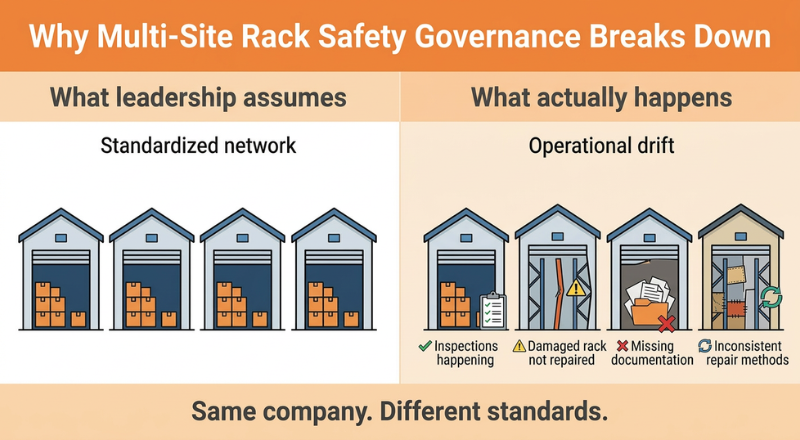
→ Inspection is not the program. Action tied to inspection is.
The Standards and Regulatory Reality in North America
For corporate leaders, governance isn’t optional. It exists inside a regulatory and engineering framework—whether you formalize it or not.
Most networks believe rack safety is a “site issue.” Regulators, insurers, and investigators treat it as a corporate responsibility. Failure to address known rack damage may be considered a recognized hazard under OSHA.
Rack safety sits at the intersection of:
- Regulation (duty to protect workers)
- Engineering guidance (accepted structural practice)
- Site records (approved capacities and configuration documentation)
United States
- The OSHA General Duty Clause requires a workplace free from recognized hazards that can cause death or serious harm.
- 29 CFR 1910.178 governs powered industrial trucks (forklifts).
- 29 CFR 1910.176 includes safe clearances and material handling requirements.
- ANSI MH16.1 provides the design, testing, and utilization standard for industrial steel storage racks.
Canada
- CSA A344:24 provides guidance on the safe use of steel storage racks.
- Occupational health and safety legislation is primarily regulated at the provincial and territorial level, meaning enforcement and requirements vary by jurisdiction.
- Provincial building codes may reference CSA standards or require an engineering review, depending on the configuration and seismic classification.
Consensus standards aren’t “laws” by themselves. But they define what “good practice” looks like during audits, investigations, and insurance reviews. Governance ensures your network consistently meets that threshold.
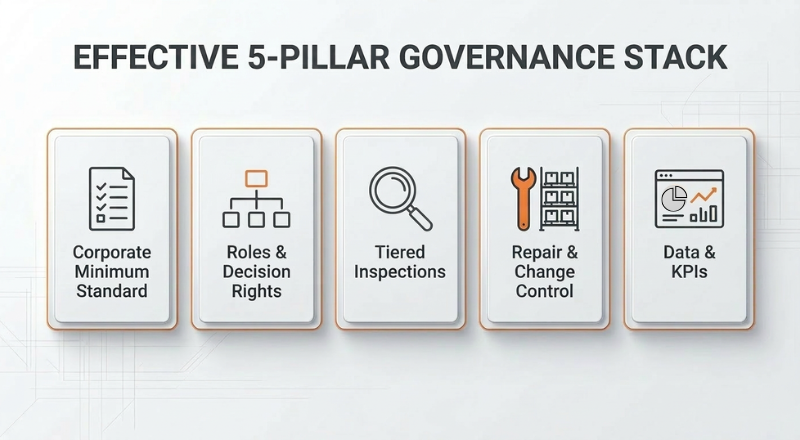
The 5-Pillar Governance Stack
Effective multi-site governance rests on five connected pillars. Each one removes a different source of inconsistency.
Pillar 1 — Corporate Minimum Standard
The non-negotiable rules every site follows.
A short, enforceable standard that defines:
- damage classification
- response timelines
- engineering triggers
- prohibited practices
- record rules
Pillar 2 — Roles and Decision Rights
Clear ownership from detection to closure.
Named accountability for triage, repair approval, engineering escalation, and closure verification. If no one owns it, it won’t close. If two people own it, it will stall.
Pillar 3 — Tiered Inspections Tied To Action
Layered detection with defined authority. Inspection is not the program. Action tied to inspection is.
- Tier 1: Daily awareness (operators/supervisors)
- Tier 2: Routine checks (trained competent person)
- Tier 3: Professional/engineering review (severe damage, changes, capacity questions)
Pillar 4 — Repair, Protection, and Change Control
Standardized structural decisions across every facility.
Approved repair methods. Protection in repeat-impact zones. Defined change control for beam moves, added levels, and load changes. No ad hoc fixes. No improvisation.
Examples of change-control triggers:
- Adding or removing beam levels
- Changing beam elevation
- Changing unit loads, pallets, or load patterns
- Swapping rack components or mixing brands
- Relocating racks or reconfiguring bays
- Repeated impacts in the same zone
- Any damage that reaches your “red” threshold
Pillar 5 — Data and KPIs
One view of risk for corporate leadership.
A system of record that answers—in minutes, not days: What’s ongoing? Where? How severe? How old? Who owns it?
Five Rack Safety KPIs Leadership Should See Monthly
- Open critical issues by site (count + age)
- Time-to-triage (median days)
- Time-to-close by severity
- Repeat-damage rate in top impact zones
- Missing records in active storage areas
If leadership can’t see it, it can’t be governed.
Six Steps to Build Governance Without Overbuilding
1. Start with 1 or 2 pilot sites
2. Standardize location mapping (site → row → bay + critical zones)
3. Adopt a red/yellow/green model with defined response timelines
4. Run weekly triage meetings (owner + due date + closure proof)
5. Standardize engineering escalations and prohibit unsafe shortcuts
6. Review five KPIs monthly, and act on them
Governance scales best when it starts disciplined and straightforward.
Your 30-Day Quick Start
This month:
- Map rack locations in one pilot site
- Train one shift on your red/yellow/green model
- Track every issue from detection → triage → closure
You’ll quickly identify bottlenecks: access windows, approval delays, vendor response times, and parts lead times.
Implementing this across multiple sites can be challenging without the right structure. Damotech’s engineers and rack safety experts can help you standardize your approach and move faster with confidence. Book a Multi-Site Governance Review.
Your One-Page Minimum Standard
Every network should define:
- Scope (which racks and areas are covered)
- Damage classifications (red/yellow/green)
- When to unload, isolate, and escalate
- Response timelines by severity
- Prohibited practices without engineering review
- Change-control triggers
- Record rules: where records live and who audits them
If it’s longer than a page, it won’t be followed consistently.
Building and maintaining a consistent rack safety standard across multiple sites can be difficult without the right structure. DAMO CARE helps you implement, manage, and sustain a network-wide rack safety program—without adding complexity.
Explore DAMO CARE.
Quick Self-Assessment
Use this in your next operations call. Answer Yes / Partial / No:
☐ We use one damage classification across all sites.
☐ Every finding has an owner, due date, and closure proof.
☐ We can list all open critical rack issues network-wide in one view.
☐ We have defined engineering triggers for severe damage and structural changes.
☐ Rack capacities and load signage are current in active storage areas.
☐ We track repeat damage zones and fund prevention accordingly.
☐ We run weekly site triage and monthly network KPI reviews.
☐ We prohibit ad hoc fixes without engineering review.
If you answered “Partial” or “No” to more than two questions, your network likely has visibility gaps that expose you to unnecessary operational and financial risk.
Repair vs. Replace: A Governance Decision
Every network should evaluate rack repairs using the same five questions:
- Severity
- Recurrence
- Downtime impact
- Compatibility
- Proof (capacity validation and documentation after repair)
Engineered repair often reduces downtime compared to full upright replacement. Replacement frequently requires complete unloading and OEM lead times (usually 8–12 weeks).
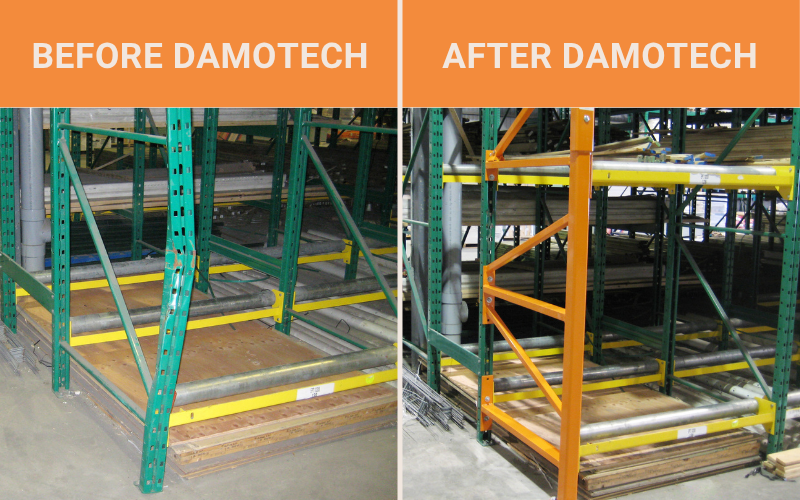
When standardized across a network, repair-first strategies can significantly reduce capital volatility and maintenance spend.
Governance can be built internally. But multi-site operators often accelerate adoption by partnering with a rack safety specialist who can standardize inspections, engineering decisions, repairs, and reporting across the network.
How Damotech Supports Governance at Scale
Multi-site governance requires engineering discipline, consistent inspection methodology, controlled repair standards, and a reliable system of record.
Damotech specializes exclusively in rack safety across North America. We support enterprise-level governance through:
- Professional inspections and load capacity validation
- Engineered rack repair solutions that restore structural performance
- Standardized protection for high-impact zones
- The Damotech Platform for network-wide visibility
- DAMO CARE subscription programs that maintain control over time
Many multi-site operators consolidate inspections, engineering, repairs, protection, and reporting under one rack safety partner to reduce variation and speed up rollout.
Bring two recent inspection reports and your site list. We’ll help you design a phased pilot and network rollout plan.
Book a Multi-Site Governance Review
FAQ: Multi-Site Governance and Rack Safety
What is rack safety governance?

Rack safety governance is the structured framework of standards, roles, inspections, engineering controls, and reporting systems used to ensure pallet racking remains structurally safe and consistently managed across multiple facilities.
What is a rack safety program?
A rack safety program is the set of rules, roles, inspections, and corrective workflows used to ensure pallet racking remains structurally safe during daily operations. In multi-site networks, governance ensures the program is consistent across all facilities.
How often should pallet racks be inspected?
Use layered inspections: daily awareness, routine competent-person checks, and periodic professional review. Escalate after major impacts or changes.
Who owns rack safety across multiple sites?
One accountable corporate owner. You need clear site owners for execution and a defined engineering authority for capacity and structural decisions.
What’s the biggest multi-site mistake?