
Quick answer: Pallet rack damage is prioritized by urgency, not just type. Most rack inspection reports sort each finding into four priority levels — Unload, High, Medium, and Low — that set what to do and how fast:
- Unload (critical): Severe damage. Unload and isolate the bay immediately, then arrange a qualified engineering review before it returns to service.
- High: Address as soon as possible. Lock out and cordon off the location until it's repaired.
- Medium: Correct promptly — typically within 6–12 months.
- Low: Document and monitor at the next inspection.
Color coding is often paired with these tiers (red = high/severe, yellow = medium/moderate, green = low/minor) to communicate findings at a glance. Priority reflects the entire frame: several low-priority findings on the same upright can combine to form a high-priority condition.
To ensure the integrity of your pallet rack systems, it’s essential to understand the various types of damage found on racks and their components. If you’ve seen damage in your warehouse, you might wonder: Is it bad? How bad?
Damotech’s inspection issue priority scale classifies findings as Unload, High, Medium, or Low. Unload issues require immediate unloading of the affected rack area. High issues require immediate corrective attention. Moderate issues should be corrected within the timeframe established in the inspection report, generally no later than 12 months. Low issues should be documented and monitored during subsequent inspections. The scale indicates the urgency of corrective action; it is different from the 1-2-3 rule used to evaluate certain visible rack deformations.
Pallet rack damage priority classification and prioritization
Racking damage classification is necessary to ensure that rack damage and issues identified during inspections are appropriately addressed to prevent any opportunity for racking failure. The following is a brief review of the different damage priorities and a classification system used to communicate findings after a baseline audit or rack inspection.
Remember that this information should be used as supplemental guidance, as tolerance for damage or risk varies from company to company. It is certainly not intended to replace the advice of a professional rack specialist or engineer.
A holistic approach to rack inspections
When conducting inspections, one must look at the racking systems as a whole. Damage is rarely an isolated issue because racks are systems with various components that all rely on each other to support stored merchandise. Consequently, one must consider the height, the load capacity, the types of loads stored, the warehouse environment, the floor on which it stands, etc. If you think the damage may be critical or you have doubts about its severity, it’s always best to unload this part of the rack and speak to a racking specialist or a qualified engineer.
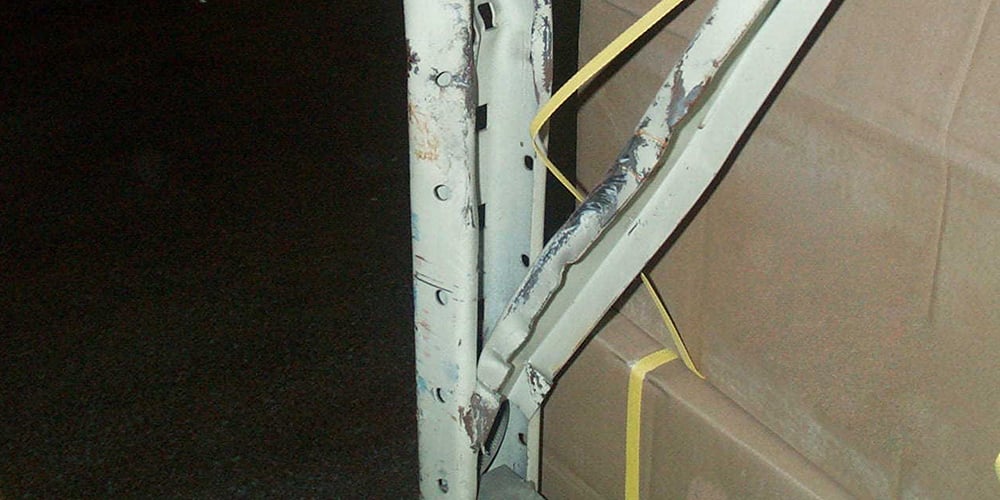
Rack damage weakens the entire structure and can pose serious safety concerns and hazards
If the rack hasn’t collapsed, it doesn’t mean the damage is not significant or that it won’t happen! At worst, rack failure can lead to a partial or full collapse of the pallet racking system, resulting in falling objects and stored merchandise, damage to the property, or serious injury to workers.
What are the pallet rack damage priority levels?
There are several ways of classifying or prioritizing rack damage. Here are three examples:
| Priority | Color | What it means | Action & timing |
|---|---|---|---|
| Unload | Red | Severe damage | Unload and isolate the bay immediately; arrange engineering review before it returns to service. |
| High | Red | Significant damage | Lock out and cordon off; repair as soon as possible. |
| Medium | Yellow | Moderate damage | Correct promptly — typically within 6–12 months. |
| Low | Green | Minor damage | Document and monitor at the next inspection. |
Some inspectors use a simpler three-tier version of this scale — Level 1 to 3, or minor / moderate / severe, color-coded green, yellow, and red — without a separate Unload tier. Whichever labels you use, emphasis should be placed on inspecting racks regularly and reporting all damage.
What's your first action when you find damaged racking?
The first action is to stop using the affected rack: control access to the location, unload the bay if the damage looks severe, then label and report it so it can be assessed and repaired. Acting quickly limits the risk of a falling load or a progressive failure before the damage is evaluated. Follow your facility’s procedure, and use this sequence as a starting point:

- Control access and unload if severe. For any finding in the Unload or High tier, cordon off the location and offload the bay before doing anything else. Take extra care when placing or removing pallets nearby.
- Lock out high-priority locations. Isolate the upright so it is no longer supporting loads, reducing the potential for collapse while it awaits repair.
- Label and date the damage. Mark the front of each affected upright with a label or tape and the date it was found, so the condition is visible and trackable.
- Report and document it. Record the location, component, and priority level with a photo in your inspection report — documentation supports follow-up and shows corrective action was taken.
- Escalate for engineering review when needed. If the damage is cracked, twisted, or sheared, or if more than one condition affects the same frame, have it evaluated by a qualified rack engineer before the rack returns to service. Damotech’s free rack damage assessment can help you confirm severity and next steps.
To identify and measure damage on each component, see our guide to rack damage signs, tolerances & limits (the 1-2-3 rule).
Can several minor damages add up to a high priority?
Some damage may not look “critical.” However, it can still lead to extraordinary consequences, especially if left unaddressed for a long time or if damage accumulates in the same upright location. These sorts of issues can seem small and sometimes hard to see, but they still need to be tended to. Additionally, a combination of several “low priority” damages on a rack system can lead to a high priority. If an issue on your pallet rack has been identified, appropriate action should be taken to remediate it.
Because a frame carries the entire bay, damaged pallet rack frames often land in the highest priority tiers — here’s how to spot and assess them before they escalate.
Finally, whichever classification system you choose to prioritize rack damage, do make sure that it is documented, labeled, and tended to in a reasonable amount of time.

Frequently Asked Questions: Pallet Rack Damage Priority Classification
Why is pallet rack damage classification important?

Classifying rack damage lets warehouse managers and inspectors judge the severity and urgency of each finding so it can be addressed before a failure occurs. Assigning a priority to every issue means corrective action — unloading, repair, or monitoring — happens on the right timeline, lowering the risk of collapse, product loss, or injury.
What are the pallet rack damage priority levels?
Rack inspectors typically sort findings into four urgency levels:
- Unload: Severe damage. Unload and isolate the bay immediately, then arrange engineering review before it returns to service.
- High: Address as soon as possible; lock out and cordon off the location until repaired.
- Medium: Correct promptly — typically within 6–12 months.
- Low: Document and monitor at the next inspection.
A color scale is often paired with these tiers — red for high or severe, yellow for medium or moderate, and green for low or minor — so findings are easy to read at a glance.
How do you prioritize rack damage?
Prioritize by how much the damage threatens load capacity and how soon it needs action — not just by what type it is. Judge each finding against field limits, then weigh the whole frame: several low-priority conditions on the same upright can combine into a high-priority hazard. When in doubt, treat it as higher priority and have it reviewed by a qualified rack engineer.
What's your first action when you find damaged racking?
Stop using the affected rack: control access to the location, unload the bay if the damage looks severe, then label and report it so it can be assessed and repaired. Acting quickly limits the risk of a falling load or a progressive failure before the damage is evaluated.
How do you document and label rack damage?
Use a consistent labeling or color-coded system (for example, green for minor, yellow for moderate, red for severe). When a location is unloaded, mark it, date it, and cordon it off. Recording each finding with photos, notes, and inspection reports helps track corrective action and shows it was completed.
How does rack damage affect warehouse safety?
Even if a rack hasn't collapsed, damage weakens the whole system. Racks are interconnected: a damaged brace, upright, or beam can reduce load capacity across several bays. Under OSHA's General Duty Clause, employers are responsible for a workplace free of recognized hazards, which includes keeping racking in safe condition (see also OSHA 29 CFR 1910.176(b)).
Can several minor damages add up to a high priority?
Yes. Several low-priority defects on the same upright or frame can combine into a high-priority hazard. Cumulative deformation and repeated forklift impacts can reduce load-bearing capacity over time, which is why regular inspection and prompt action matter even for minor findings.
When should you bring in a rack engineer?
Escalate for qualified engineering review when damage is cracked, twisted, or sheared rather than a smooth deformation, when more than one condition affects the same frame, or when anchors, connectors, or welds are involved. ANSI/RMI MH16.1 recommends isolating and professionally evaluating a rack in these cases before it returns to service. Damotech's free rack damage assessment can help you confirm severity and the safest next step.
How can Damotech help you classify and prioritize rack damage?
Damotech provides rack inspection and engineering evaluation to help you classify findings, assign the right priority, and plan corrective action — including engineered repairs and updated load-capacity labels — so damaged racking is restored to its rated capacity.