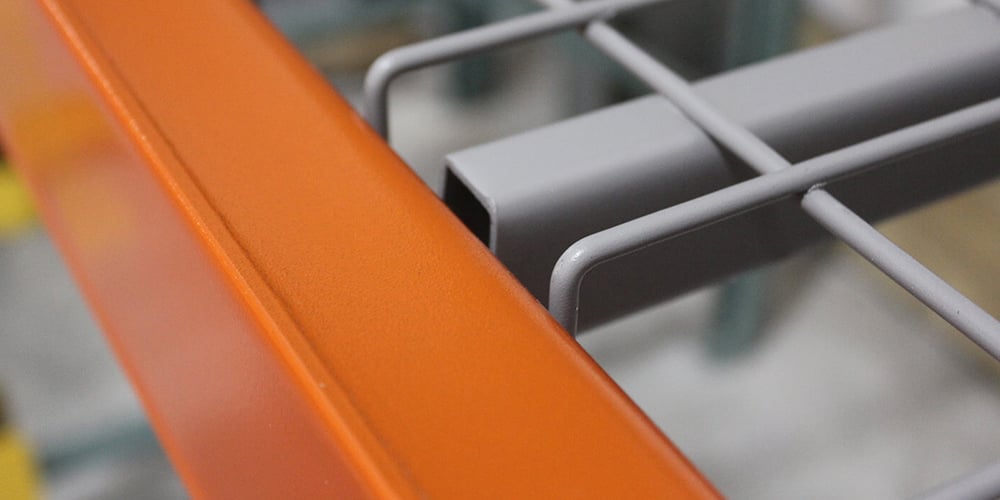

In addition to ensuring the conformity of his pallet racks, an employer must also make sure that pallet loads and goods are stored in a way that prevents them from falling. This type of incident can occur because of damaged pallets, loose packaging, failure to securely place materials in the storage rack by forklift operators, or the inadvertent pushing of stored materials by operators too far out of the storage rack position into the adjacent aisle. Since pedestrians often use rack tunnels to travel from one aisle to another, I’ve often been asked:
Do you need wire mesh rack decking on every beam level in a rack tunnel?
The short answer is no. Typically, only the first beam level in a tunnel must have wire mesh rack decking (or sometimes called wire mesh partitions) to help catch any falling debris or product.
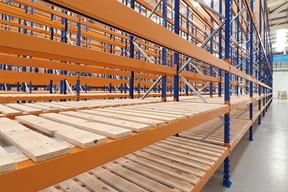
What the Codes and Standards Demand for Wire Mesh Partitions
OSHA’s Role in Wire Mesh Partitions
OSHA has issued very general regulations regarding the use of industrial shelving in the workplace. Article 1910.176(b) is the closest thing to apply to such a situation. Ultimately, it states that warehouse management is required to take all the necessary measures to protect workers. Using a wire mesh partition on the first beam level of a rack tunnel is one way to help protect pedestrians.
Here is an excerpt of the article:
“…storage of material shall not create a hazard. Bags, containers, bundles, etc., stored in tiers shall be stacked, blocked, interlocked, and limited in height so that they are stable and secure against sliding or collapse.”
OSHA’s General Duty Clause, which requires an employer to offer a place of employment, which is free from recognized hazards, provides a broader provision under which the agency can cite an employer for failure to prevent or correct a “recognized” hazard.

What the American National Standards Institute Requires for Wire Mesh Decking
ANSI MH16.1, the rack design code specified in the IBC (International Building Code) for use in the US, states that protection may be required. Below are excerpts from this standard:
12.3.8 Product Fall Protection
The design shall consider any locations where operations would require horizontal or vertical safety barriers to prevent product from falling.
Again, it’s essentially up to the owner to recognize and prevent objects from falling.
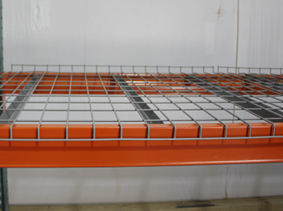
According to the Product Fall Protection Commentary (C12.3.8) within ANSI MH16.1:
There can be systems in place to protect areas within or around the structure from products that could accidentally fall. Often, these locations are areas where people could be situated, or areas where falling product could cause other types of property damage or present a safety hazard. These areas should be identified by the owner and brought to the attention of the registered design professional. Proper barriers, if required, should be supplied and installed. These requirements will vary depending on the products, the operation, and the configuration of the structure.
Now, you may be asking yourself if the wire mesh rack decking must be fixed to the rack beams?
Design codes ask for safety bars to be fixed to the beams (front and back) because they can move from side to side. However, there is no clear recommendation in the codes for wire mesh decking. We know that although waterfall type wire mesh will not laterally move and cannot just fall off the rack, it is better to attach them to beams as they sometimes can get lifted by pallets during handling operations.
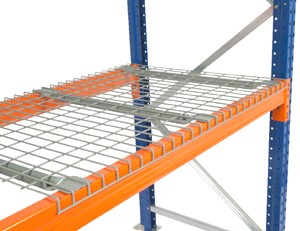
Best Practices for Wire Mesh Decking and Warehouse Safety Compliance
There is no such thing as too much prevention. Regular inspections should be conducted to identify possible hazards, and the use of fall protection accessories such as safety bars and wire mesh partition, can be used where objects could fall and potentially injure workers.

Frequently Asked Questions About Wire Mesh Rack Decking and Tunnel Safety
Do I need wire mesh rack decking on every beam level in a rack tunnel?

No. Typically, only the first beam level in a rack tunnel requires wire mesh rack decking (also referred to as a wire mesh partition). This barrier is designed to catch falling debris or products and protect pedestrians who use rack tunnels to move between aisles.
What does OSHA say about preventing falling objects from pallet racks?
OSHA’s material handling regulation, 29 CFR 1910.176(b), states that “storage of material shall not create a hazard.” It requires that loads be stacked, blocked, interlocked, and limited in height so they remain stable and secure against sliding or collapse.
Warehouse managers must take proactive steps, such as wire mesh partitions, safety bars, or proper stacking methods, to prevent objects from falling onto workers or into adjacent aisles.
What does ANSI MH16.1 require for product fall protection?
According to ANSI MH16.1 (RMI Rack Design Standard), Section 12.3.8, the design of a storage rack must consider any areas that require horizontal or vertical barriers to prevent product fall.
The commentary (C12.3.8) further clarifies that the owner should identify areas where people may be present or where falling items could cause damage or injury. The qualified rack expert should then recommend appropriate barriers, such as wire mesh decking or safety partitions, based on the rack’s use, configuration, and environment.
Should wire mesh decking be fixed to the rack beams?
What are the best practices for preventing falling objects in rack tunnels?
- Install wire mesh decking on the lowest beam level of tunnels.
- Inspect regularly for damaged pallets or loose packaging.
- Train forklift operators on safe placement and handling of palletized goods.
- Add secondary fall protection (safety bars, netting, or panels) in high-traffic or high-risk areas.
- Perform regular rack inspections to identify hazards before they lead to incidents.
Following these practices aligns with OSHA’s General Duty Clause (§5(a)(1)), which requires employers to maintain a workplace free of recognized hazards likely to cause injury.
Who is responsible for deciding where fall protection is needed?
How often should I inspect wire mesh decking and partitions?
Although OSHA and ANSI don’t specify an exact frequency, inspections should be performed regularly as part of your warehouse’s rack safety program.
A good rule of thumb is to:
- Conduct visual checks monthly, and
- Schedule annual third-party rack inspections to ensure compliance and identify hidden risks.
What other OSHA standards support the use of wire mesh or barriers in tunnels?