

Quick answer: A pallet rack beam is the horizontal load-bearing member that spans between two upright frames and carries the pallets on each level. Pallet rack beams carry your inventory between the upright frames — but they do two jobs that are easy to overlook: they give the racking system horizontal rigidity against sway from seismic activity and forklift forces, and they brace the uprights against torque and buckling. Keeping beams correctly spaced, locked, loaded, and undamaged is what keeps the whole system stable.
Key beam specs at a glance: maximum deflection L/180 · beam connectors must resist 1,000 lb uplift (RMI) · pallets should overhang the front and rear beams 2–4 in · allow about 3 in clearance around the pallet · damaged beams are replaced with OEM parts, not repaired.
Pallet rack beams are a critical component of your racking system, bearing the weight of valuable inventory and keeping operations efficient. They are engineered for specific loads, and a few details, if neglected, can lead to structural failure. This article covers the beam best practices every warehouse manager should know to maintain a safe, efficient operation.
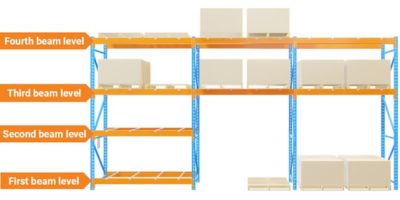
How critical are pallet rack beams
There are three essential facts about pallet rack beams. The most obvious: they hold the weight of your inventory between the upright frames. The two less obvious roles are often overlooked:
- Horizontal rigidity. Beams resist lateral displacement and sway under seismic activity and dynamic forces, such as forklift impacts.
- Torque resistance for the upright. By bracing the upright columns, beams reduce the risk of deformation or buckling under concentrated vertical loads at lower levels.
Maintaining the structural integrity of your beams is central to warehouse safety and efficiency. The sections below cover the details that prevent beam failure.
Correct installation of pallet rack beams
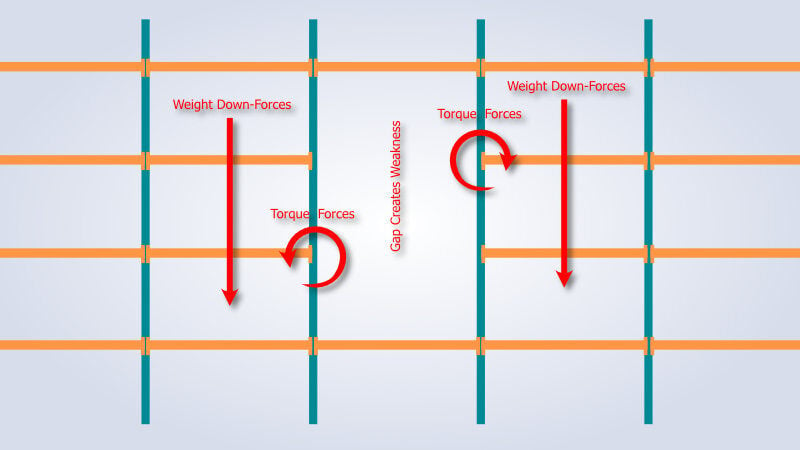
Proper pallet rack beam spacing
Beams should be specified by a qualified engineer familiar with the load dynamics of pallet racking systems. If the size or weight of your inventory changes, or if beam requirements are altered, consult an engineer — they may specify different vertical beam spacings.
Any change to beam spacing should be carried out under engineering supervision with documentation, because the spatial configuration directly affects load capacity and stability. Larger beam gaps reduce horizontal rigidity, putting more torque on the upright columns. Never adjust beam spacing without adhering to the original design or consulting a qualified engineer.
Beam connectors, clips, and safety pins
Use the beam clip or engagement-pin system specified by the OEM to connect beams to columns, unless an alternate engineered connection has been approved. Inspect each clip or pin to confirm it is fully engaged. On roll-formed uprights, a safety clip or pin is often added so the connection cannot disengage accidentally.
RMI specifies that beam-locking devices are required to prevent accidental dislodgement caused by forklift activity. These devices — bolts, pins, hooks, or other approved connectors — must satisfy the RMI 1,000-pound uplift requirement. Disengaged pins or clips can lead to beam failure and cascading damage.
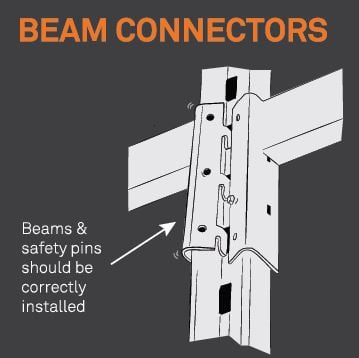
Do not assume a bigger bolt is a better replacement. Clips and pins are engineered for your system — sometimes engineered to fail under specific conditions to protect the system overall. Never substitute an aftermarket bolt for a missing J-pin or safety clip unless a qualified engineer approves it.
Proper loading and labeling
Each beam has a rated load set by the engineer who designed the system, and that rating must be displayed. Label beams with their rated load on the front, facing the aisle.
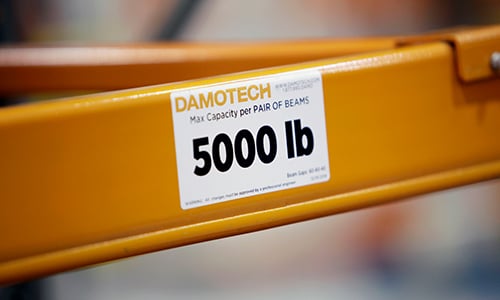
RMI also recommends posting system load-capacity plaques at the end of each row. To estimate or verify what your system can carry, use our load capacity service and review how load-applied rack capacity (LARC) is determined — those resources cover capacity in depth.
Loads must be evenly distributed and balanced across the beams. If your warehouse management system supports it, your loading software can provide an even distribution pattern; otherwise, a visual inspection helps confirm the load is balanced.

Proper decking and pallet fit
When decking is used, install it to the engineered specifications of your system. Evaluate wire mesh or wooden decking carefully and confirm the material and configuration meet your structural requirements and local fire and load codes. Always confirm with a qualified engineer that the decking suits your inventory, pallet types, and application.
Pallet sizes should match the original design. Pallets should overhang the front and rear beams by 2 to 4 inches. Decking or pallet failures can shift or drop inventory, causing rack damage, hazards, and injuries.
Pallet rack beam types: box beam vs. step beam
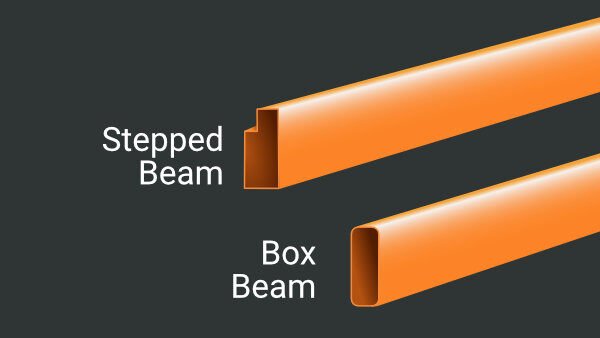
The two most common pallet rack beam types are box beams and step beams. The difference is the step ledge: a box beam has none, so wire decking sits on top, while a step beam has an interior ledge that supports the decking from inside.
| Feature | Box beam | Step beam |
|---|---|---|
| Interior step slot | None | Has a step ledge |
| How wire decking sits | On top of the beam | Supported in the step slot |
Pallet rack beam length
Beams come in various lengths; the right length accommodates your pallets, typically allowing about 3 inches of clearance around the pallet. As beam length increases, gauge must increase so the beam can support the load. The engineer calculates the total load — adhere to those specifications.
Pallet rack beam size and gauge
Steel type and thickness determine load-bearing capacity, and steel weights and gauges are not visually identifiable — always refer to the original engineering plans. RMI recommends against mixing beams from different manufacturers; ensure replacements meet the original specifications.
Damage to pallet rack beams
Forklift and loading-vehicle impact
Impacts are the most common source of beam damage, especially when the loading vehicle is too large for the aisle. They can dent or shear beams and deform or disengage safety pins and connectors. Damage can occur both in the bay being loaded and in bays backed into across the aisle. Use the correct equipment for your design, operated by trained staff, and have drivers report every impact, minor or major.

Improper loading and overloading
Overloading bends beams. Slight deformation is acceptable, but it becomes hazardous once it exceeds the allowable limit.
Pallet rack beam deflection limit: a beam should not deflect more than L/180, where L is the beam length. Beyond that, unload the beam and have it assessed.
Unauthorized modifications
Staff may not appreciate how precise beam positioning needs to be. Some assume safety pins let beams be relocated freely, and beams are sometimes removed for traffic or oversized inventory. These changes alter torque forces in the upright and can cause upright failure, without visible bends or dents. Train staff never to move a beam without consulting a qualified engineer.
Seismic events
Earthquakes cause twisting and torsion that can damage beam connectors, safety pins, and column pinholes. After a seismic event, schedule a professional inspection as soon as possible.
Corrosion
Corrosion is especially hazardous to the small pins and clips that secure beams, and beams themselves can rust in harsh conditions. Pay close attention to the lowest section of the upright and to welds connecting beams, clips, and baseplates. Corrosion is not always visible from the front — inspect from multiple angles, and use galvanized components where rust is common.
Upright damage
Beams rely on a secure upright connection. Uprights can be damaged by twisting during install or removal, forklift impacts, or seismic events. When repairing, assess both uprights and beams. A trained Damotech professional can help confirm components are properly inspected and meet engineering standards.
How to inspect pallet rack beams
Once installed, racking should be inspected regularly so severe damage is caught early. Combine ongoing informal checks with scheduled formal inspections, and document them — inspection logs are useful in the event of an OSHA inspection.
Informal inspections
You and your team should perform ongoing informal checks and encourage workers to report damage. Damotech’s inspection checklist supports these. Informal checks never replace formal inspections by trained professionals conducted in line with RMI standards.
Formal inspections
RMI guidance calls for routine formal inspections based on your system’s load and usage. Document the specific location of any of these conditions:
- Bent beams or downward deflection exceeding L/180.
- Missing, disengaged, or corroded beam clips.
- Missing or unreadable load labels.
- Beam connectors disengaged, bent, or showing weld failures.
- Dents, cuts, or cracks in beams or connectors.
- Loading that does not conform to your system’s load standards.
- Missing beams that have been moved or removed.
Pro tip: Check behind-beam connectors and front/rear beams, unload them if needed, and use a lift to inspect higher levels. Report all temporary repairs.

Pallet rack beam replacement
Beams are typically replaced with identical OEM parts as specified in the original design, not repaired. Minor issues with locking pins or connectors may be addressed using methods approved by the manufacturer or a qualified engineer. When damage is found, offload the beam and move inventory; severe damage can compromise the entire upright.
Upright damage can shear, bend, or twist beam punch holes. Never reinstall a damaged beam into a damaged upright. Repair both first. Upright damage often occurs just above or below a beam and may require replacing the upright section where the beam attaches; doing this without engineering oversight can compromise the whole system.
Signs a pallet rack beam should be unloaded and assessed for replacement:
- Downward deflection exceeds L/180, or the beam is visibly bent.
- Dents, cuts, or cracks in the beam or its connectors.
- Weld failure at the beam-to-connector joint.
- Connectors that are sheared or damaged (a merely disengaged clip may only need re-engaging)
Standards that apply to pallet rack beams
ANSI MH16.1 places responsibility for maintaining and repairing the system on the operator, requires that visibly damaged sections be unloaded and removed from service until repaired or replaced, and sets the L/180 deflection limit. These rules apply to all pallet racking, cold-formed or hot-rolled, movable or fixed. For the full breakdown of load-capacity calculation requirements, see our dedicated guide → ANSI MH16.1: Updated Load Capacity Calculation Requirements for Racks.
Key takeaways
- Install beams to manufacturer specifications, with capacities displayed.
- Inspect beams informally and formally at regular intervals, and document formal inspections.
- Keep deflection within L/180 and ensure connectors meet the 1,000 lb uplift requirement.
- Match beam shape, length, and gauge to the original engineering design — never improvise.
- Rely on qualified engineers for inspections, repairs, and replacement parts.
Contact Damotech if you need help keeping your personnel and warehouse safe and efficient.
Frequently asked questions about pallet rack beams
What is a pallet rack beam?

A pallet rack beam is the horizontal load-bearing member that runs between the upright frames of a pallet racking system. Beyond carrying inventory, it gives the system horizontal rigidity against sway and braces the uprights against torque and buckling.
What is the maximum deflection allowed for a pallet rack beam?
The maximum allowable beam deflection is L/180, where L is the length of the beam. Deflection beyond this limit signals overloading or damage and the beam should be unloaded and assessed.
What is the difference between a box beam and a step beam?
A box beam has no interior step slot, so wire decking sits on top of it. A step beam has a step ledge that supports crossbars and wire decking from inside. Always match the beam shape specified in your original system design.
How much should a pallet overhang the rack beams?
Pallets should overhang the front and rear beams by 2 to 4 inches, and the beam length should allow roughly 3 inches of clearance around the pallet. Deviating from the original design specification can compromise structural integrity.
What is the uplift requirement for pallet rack beam connectors?
RMI specifies that beam-locking devices must resist 1,000 pounds of uplift to keep beams from dislodging during forklift activity. Locking devices may include bolts, pins, hooks, or other approved connectors.
Should pallet rack beams be repaired or replaced?
Damaged pallet rack beams are typically replaced with identical OEM parts rather than repaired. Minor issues with locking pins or connectors may be addressed using methods approved by the manufacturer or a qualified engineer.
Where do I find the load capacity for my pallet rack beams?
Your beam capacity is set by the engineer who designed the system and is shown on the load plaque. To review your system's capacity, use our load capacity service and learn how load-applied rack capacity (LARC) is determined, rather than relying on the beam label alone.
How often should pallet rack beams be inspected?
Teams should perform ongoing informal inspections, while formal inspections by trained professionals should follow RMI guidance based on the system’s load and usage. Document every formal inspection for your records.