Free Webinar
Warehouse Safety Mistakes

Damotech
Damotech
Damotech

Lessons from 35 Years of Inspections

ABOUT THE WEBINAR

Daily operational pressures, limited training, evolving storage needs, and tight budgets often prompt teams to adopt solutions that seem practical and efficient in the moment. A beam is moved to fit a new load. A replacement part that “looks the same” is installed. A damaged upright is temporarily repaired to keep operations running smoothly.  

While these decisions are often made with good intentions, they can inadvertently introduce significant safety, compliance, and structural risks. 

What You’ll Learn  

  • Why well-intentioned fixes often lead to unsafe conditions
  • Common mistakes uncovered during professional rack inspections 
  • How rack reconfigurations and component compatibility affect load capacity
  • What safety standards require—and what operators are responsible for 
  • How to replace unsafe workarounds with compliant, long-term solutions 

Date: February 3, 2026 

Time: 12 PM (Eastern Time) 

Format: Live online (Zoom)
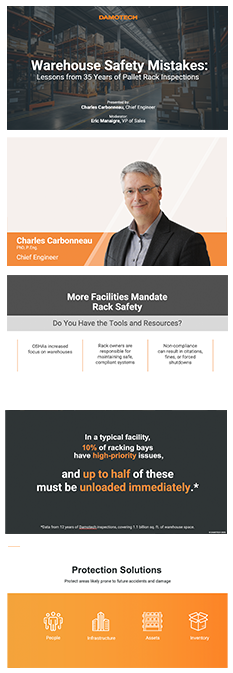
Thumbnail of a MODEX 2026 seminar about warehouse safety mistakes.

Fill out the form and enjoy the webinar recording.

Learn more about this webinar

After more than 35 years of inspecting pallet racking systems across North America, one reality stands out: most warehouses don’t intend to operate unsafely—yet many unknowingly do. 

In this webinar, Charles Carbonneau, structural engineer and head of Damotech’s engineering team, shares the most revealing lessons learned from three decades of real-world rack inspections. Drawing from thousands of facilities and countless inspection reports, he will explain why “good enough” fixes so often conflict with safety standards and how seemingly minor decisions can have significant consequences. 

You will gain a clearer understanding of how pallet racking systems behave under load, why mixing components or reconfiguring racks without engineering oversight is dangerous, and how overlooked damage can escalate into compliance issues or rack failures. Real inspection findings will be used to illustrate how and where warehouses commonly go wrong. 

Most importantly, this session will help you recognize the early warning signs of unsafe practices in your own facility and provide practical guidance on what to do instead. You’ll leave with a stronger understanding of applicable standards, clearer inspection priorities, and actionable steps to reduce risk while maintaining operational efficiency.

This webinar is designed for:

  • Warehouse Managers 
  • Safety Officers & EHS Professionals 
  • Operations & Facilities Directors
  • Facility Maintenance Professionals 
  • Logistics & 3PL Operators

FAQ

Out of the most common rack safety mistakes, which one is seen most often in warehouses?

FAQ arrow
By far, the most common issue is unknown or undocumented load capacity. In many warehouses, load capacities are not displayed, are outdated, or are no longer valid after rack modifications. This comes up repeatedly during inspections—especially in facilities that have been acquired, expanded, or reconfigured over time.

What makes this risk so underestimated is that capacity information is often lost in paperwork, emails, or employee turnover. Companies that address this successfully treat load capacity as critical data: they validate it through engineering, document it clearly, and ensure it remains accessible over time. That’s what creates consistency, clarity, and safer day-to-day decisions on the warehouse floor.

If rack damage is spotted during a shift, what are the first two steps employees should take?

FAQ arrow

Act to reduce risk and get the issue evaluated.

  1. Identify and flag the damage so it’s clearly reported.
  2. Secure the area and prioritize the issue, including partial unloading or cordoning off the affected locations if there’s uncertainty.

Because rack damage can be difficult to assess without engineering expertise, a qualified professional should then evaluate the situation to determine the appropriate response.

How should we prioritize rack damage when there are many issues across a warehouse?

FAQ arrow

Damage is prioritized based on risk, not appearance. Issues are classified by severity—unload, high, moderate, or low—but multiple issues at the same location can combine to create a higher overall risk. That’s why damage must be assessed by asset, not in isolation.

It’s also important to note that once damage exists, there is no reliable way to estimate how much load capacity has been lost or to safely compensate by loading less. Damage must be addressed through repair, replacement, or engineering review. Treating findings as data allows risks to be ranked objectively and addressed in the right order.  

What are the early signs that a small rack issue is getting worse?

FAQ arrow

Progressive damage is the key warning sign. 


Corrosion is a common example—once it starts, it doesn’t stop. Surface rust may be minor, but section loss (often around 10% steel thickness) signals that structural integrity is compromised and the issue will continue to worsen. Early identification allows corrective action before damage becomes irreversible. 

Which of the common rack safety mistakes is the easiest to fix quickly?

FAQ arrow

Small hardware issues—such as loose anchor bolts or missing safety pins—are often the quickest and least costly to correct. When addressed promptly and in line with engineering requirements, these fixes can significantly reduce risk. Regular inspections and manufacturer-approved components help ensure these simple issues don’t turn into serious hazards.

Can Damotech determine load capacity limits for existing rack systems, even older ones without placards?

FAQ arrow

Yes. This is a core part of what we do. Our engineers can assess existing racking systems—including older installations—by measuring the components on site and performing load capacity calculations. Based on that analysis, we can issue compliant load capacity labels or placards for each rack bay.

When CSA or RMI guidelines change, does that mean existing rack load capacities need to be updated?

FAQ arrow

Not automatically. If a rack system was previously certified and there have been no changes to its configuration, condition, or use, the posted load capacity typically remains valid. During your next inspection, Damotech experts will review the existing certification and only recommend re-certification if the setup or loading has changed, the original certification can’t be verified, or a site-specific or regulatory requirement calls for an update.

Are load ratings required to be posted on pallet racking, and what standard requires this?

FAQ arrow

Yes. ANSI MH16.1-2023 requires that rack systems be identified with one or more load plaques. Section 4.5 (“Load Plaque”) states that load plaques must be displayed on or near the rack system to clearly indicate the allowable load ratings.

Is there a minimum lighting (lux) requirement for rack aisles, and does poor lighting contribute to rack damage?

FAQ arrow

There is no single minimum lux requirement in CSA or RMI standards for rack aisles, as these are racking standards—not lighting standards. However, poor lighting can contribute to damage by reducing visibility and increasing the likelihood of impacts. Most facilities reference IES (Illuminating Engineering Society) recommendations, which suggest approximately 10–30 footcandles (about 100–300 lux) for warehouse aisles. These values are guidelines, not code requirements.

If anchoring pallet racking is prohibited by a lease, what engineered options exist to ensure rack stability—and where is the hard stop?

FAQ arrow

For pallet racking operated by forklifts, anchoring is typically required to ensure stability and structural integrity. In standard rack systems, operating without anchors is generally not acceptable unless the system was specifically designed and engineered to be freestanding, which is rare.

If a lease restricts anchoring, this becomes a fundamental constraint that must be addressed before normal forklift operation can continue. In some limited cases—such as hand-picking operations or very specific engineered designs—alternative solutions may be possible, but these must be reviewed and approved by a qualified engineer.

In practice, anchoring restrictions often serve as a hard stop until the rack system, operating type, or lease conditions are reassessed with proper engineering input.

What’s the main thing I should learn from Damotech’s 35+ years of experience?

FAQ arrow

Get into a program.

Good intentions don’t stand the test of time, and rack safety isn’t something most warehouse teams can manage consistently on top of daily operations. The facilities that perform best are the ones where leadership invests in a structured rack safety program that runs continuously, reduces repeat issues, and allows operators to focus on running the business—while the system takes care of safety, follow-up, and long-term risk.

Is it generally acceptable to store loads on the top or last shelf of a pallet rack system?

FAQ arrow

In the US, yes. The racking standard ANSI MH16.1-2023 requires racks to have one or more load plaques posted on or near the rack system. In Canada, it depends on the province, but load ratings are commonly expected to be posted.

When load capacities are posted on the racking, how should material handlers determine the weight of the loads they are placing in the rack?

FAQ arrow

Don’t guess. Use a known source. Unit weight x quantity plus pallet tare from the product spec, supplier, or your WMS. If the exact pallet weight isn’t confirmed, weigh a typical pallet and the heaviest pallet on a floor or lift scale, then use the worst case when comparing to the rack plaque.

Are adhesive anchoring solutions acceptable for pallet racking? If so, what limitations or trade-offs should be considered compared to mechanical anchors?

FAQ arrow

Yes, adhesive anchors can be acceptable for pallet racking, but only if they are the specified anchor in the engineered anchorage design. ANSI MH16.1 ties anchor design to ACI 318 Chapter 17.

Adhesive anchors work, but they’re less forgiving. They rely on perfect installation and the right site conditions, and they need cure time. Mechanical anchors are usually quicker and simpler. Either way, don’t swap anchor types on site without an engineer signing off.

Speaker

Charles_Full_Transparent_350x350

Charles Carbonneau

Chief Engineer at Damotech

Charles is a structural engineer (Ph.D.) with over 25 years of experience in structural dynamics. He is renowned for the depth of his knowledge about racking systems and his dedication to finding innovative rack safety solutions. 

Damotech
Damotech
Damotech