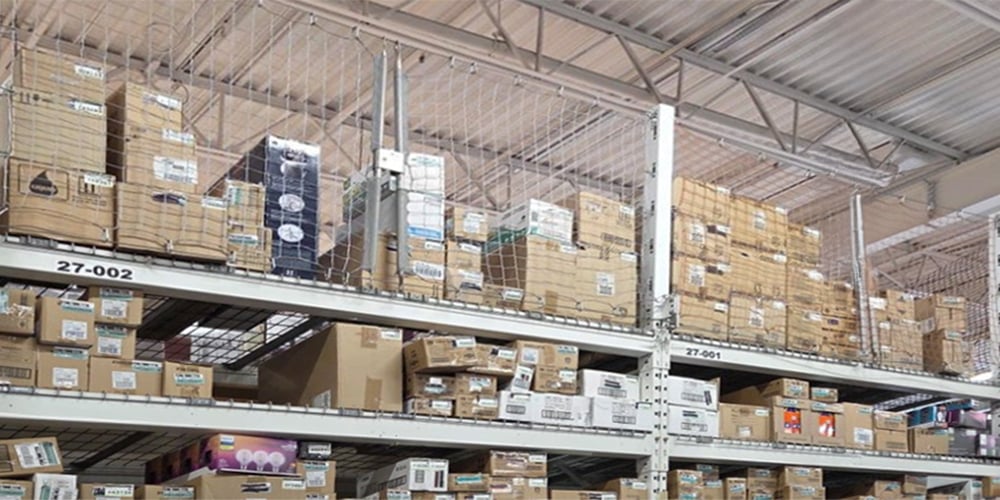

High-bay storage has become a standard solution for maximizing warehouse space and increasing storage density. As facilities grow taller and operations move faster, however, the risk of falling products increases. Items dislodged from pallet racks can cause serious worker injuries, inventory damage, and operational disruption.
According to the U.S. Bureau of Labor Statistics, “struck by object or equipment” incidents— which include falling objects—account for more than 50,000 workplace injuries involving days away from work each year in the United States. In warehouse environments, falling-object hazards are a recognized safety risk that must be properly controlled.
Pallet rack safety netting is one solution used to help mitigate this risk. Acting as a protective barrier, it helps prevent products from falling from elevated storage levels, reducing liability exposure while protecting employees and inventory.
This article explores the role of pallet rack netting in warehouse safety, the different types available, applicable considerations, and best practices for implementing pallet rack safety netting in high-bay storage environments.
The Importance of Safety Netting in Warehouse Safety
High-bay storage systems are commonly used in warehouses because they efficiently utilize vertical space. This approach is essential when floor space is limited, and storage demands continue to grow. However, as rack heights increase, the potential severity of falling-object incidents increases.
Products stored at elevated levels can become dislodged due to improper loading, pallet overhang, impact from material handling equipment, or shifting inventory. When items fall from significant heights, the consequences can be severe. Worker injuries, product damage, and operational disruption may also lead to financial losses, insurance claims, and reputational harm.
For this reason, warehouse operators must evaluate falling-object hazards as part of their overall rack safety strategy. Adding rack safety netting in specific areas can help reduce exposure to these risks and support a safer working environment.
What Is Rack Safety Netting?
In high-bay storage environments, pallet rack safety netting is commonly installed behind rack bays or beneath elevated levels to contain falling products before they reach work areas below. Creating a physical containment system helps reduce the likelihood of injury and product loss.
Rack safety netting is typically available in two main formats:
- Modular netting – Covers a single opening in standard sizes, but not entire bays. They are more versatile and easier to install.
- Standard netting – Covers an entire bay or a long series of them in a row and requires more tools and time to install.
The two most used configurations include:
- Vertical Safety Netting
Installed along the sides of storage racking systems to prevent products from falling into aisles and pathways. - Horizontal Safety Netting
Installed beneath pallet racks to catch falling items before they can cause harm.
Custom rack safety netting solutions can also be designed to accommodate unique warehouse layouts and risk exposures.

Key Benefits of Rack Safety Netting in High-Bay Storage
Rack safety netting offers several practical benefits in high-bay storage environments.
1. High Strength to Low Weight Ratio
Despite its lightweight nature, a netting system boasts an impressive strength-to-weight ratio. This attribute allows it to effectively withstand heavy loads and impacts while minimizing the overall weight of the structure.
2. Pliable Nature
Safety netting exhibits excellent pliability and resilience. This allows it to adapt to various shapes and configurations without losing its structural integrity. Under impact, the netting temporarily deforms to absorb energy and then returns to its original shape, reducing stress on the racking system while ensuring long-term durability and reliable performance in demanding warehouse environments.
3. Reduced Liability
Rack safety netting can reduce liability risks. In high-bay storage environments, where the risk of items falling is high, it serves as a protective shield, helping prevent accidents. By preventing worker injuries and damage to inventory, businesses can reduce the risk of legal claims, workers’ compensation expenses, and reputational damage.
4. Enhanced Workplace Safety
High-bay storage environments can pose significant risks to workers, particularly during pallet loading, unloading, or product retrieval from elevated rack levels. Safety netting helps mitigate these hazards by intercepting falling items before they can reach work areas below, reducing the likelihood of worker injury.
5. Protection of Inventory
Items that fall from great heights can sustain significant damage, leading to product loss, waste, and increased replacement costs—particularly in industries handling fragile or high-value goods. By reducing the likelihood of falling items, storage rack safety netting helps preserve inventory integrity and operational efficiency.
6. Ensuring Compliance with Safety Regulations
Compliance with safety regulations is essential for any business. In warehouse operations, adhering to safety standards, such as those established by OSHA (Occupational Safety and Health Administration), helps ensure that businesses avoid fines and maintain a safe working environment.
By incorporating safety nets into high-risk areas, businesses demonstrate proactive hazard mitigation and a commitment to workplace safety, particularly in high-bay storage areas where the risk of falling objects is significant.
Netting should be considered alongside other safety measures such as proper load placement, rack inspections, beam safety devices, pallet condition monitoring, and impact protection systems.
Not sure of the safety in your warehouse? Read our blog about the most common OSHA violations in warehouses.

Types of Rack Safety Netting
Several types of rack safety netting are available to address different storage configurations in high-bay environments.
1. Offset Rack Safety Netting
Offset safety netting is available in sizes ranging from 2" to 12" and is commonly used when pallets or stored products overhang rack beams. The offset design creates extra depth to help catch products before they fall into aisles or work areas. It is secured with engineered brackets, ensuring the netting panels remain in place and reducing the risk of gaps through which items could potentially fall.
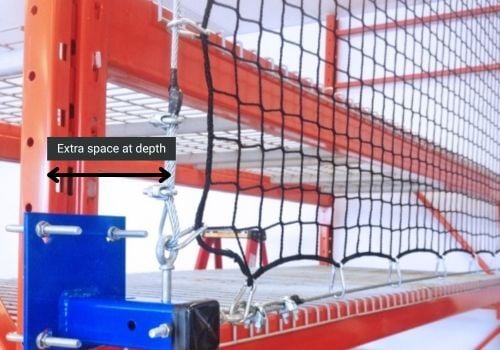
Offset rack safety netting. Photo credit: LiftSafe.
2. Flushmount Rack Safety Netting
This safety netting is ideal for environments where products are not prone to overhang or are loaded by hand. It is affixed directly to the rack, leaving no space for products to fall through.
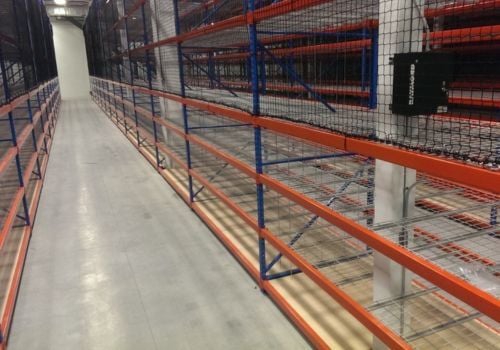
Flushmount rack safety netting. Photo credit: LiftSafe.
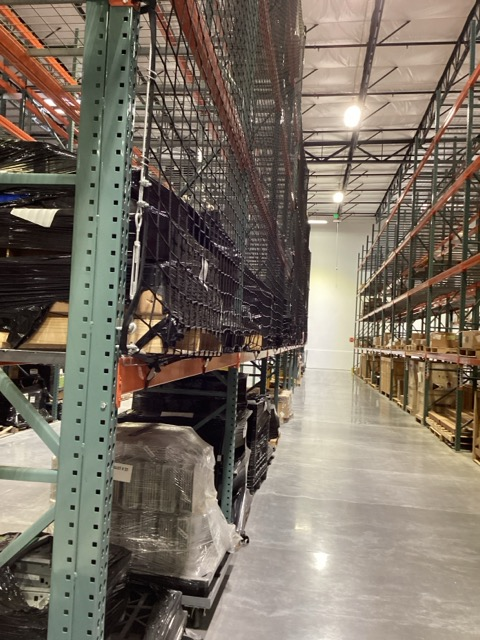
The image below shows a non-ideal use of a flushmount safety netting, where the pallet used to store the product is overhanging and stretching the netting. Improper application can reduce effectiveness and should be evaluated carefully during system selection.
3. Frame Extension Rack Safety Netting
Frame extension systems are designed to extend past the height of existing pallet racking systems. They allow the netting to cover higher areas without compromising safety or product integrity. The netting can be either flush or offset.
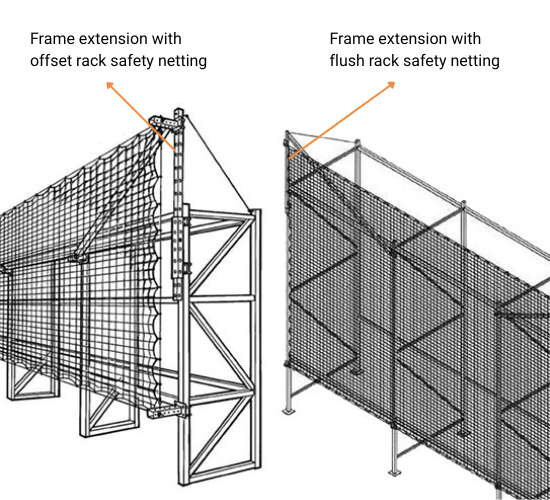
Frame Extension rack safety netting. Photo credit: Cisco-Eagle.
4. Horizontal Rack Safety Netting
Horizontal safety netting is often used in tunnel-style rack configurations or in areas where workers operate beneath storage systems. Horizontal nets are positioned under rack systems to intercept falling items.
Horizontal rack safety netting
Safety Netting Requirements
Safety nets can play an important role in reducing falling-object hazards, particularly in environments such as warehouses and distribution centers. Warehouse safety in North America is governed by a combination of OSHA standards for the USA and provincial regulations for Canada.
OSHA Requirements for Falling-Object Protection
OSHA does not have one specific “netting law” for pallet rack systems. Instead, it enforces falling-object protection through several general industry standards.
The General Duty Clause (Section 5(a)(1))
Often referred to as OSHA’s “catch-all” provision, this clause requires employers to provide a workplace free from recognized hazards likely to cause death or serious physical harm. If falling pallets or stored materials present a recognized hazard and no protective measures are in place, employers may be cited.
29 CFR 1910.176(b)
This regulation states that “storage of material shall not create a hazard.” In practical terms, materials must be stacked, blocked, interlocked, or otherwise secured to prevent sliding or collapse.
In warehouse environments, this may involve implementing engineering controls, such as safety netting, rack backing, beam safety devices, pallet containment systems, or other protective measures.
CSA A344 and Rack Safety Netting Considerations
In Canada, CSA A344 provides guidance on rack configuration and safe use. Rack safety netting is not explicitly required by these standards, but may be implemented as part of a broader risk mitigation strategy.
Best Practices for Implementing Rack Safety Netting
When implementing rack safety netting, several best practices should be followed to ensure optimal effectiveness.
1. Assess Warehouse Needs
Before installing pallet racking netting, assess the specific needs of your warehouse: Take the time to evaluate the risks and identify high-risk areas that require protection. By conducting a thorough assessment, you can determine the type of netting that will best suit your warehouse layout and operations.
2. Choose the Right Type of Pallet Racking Netting
Choosing the appropriate type of rack safety netting is essential to maximize safety. Consider the specific needs of your warehouse, then choose between vertical and horizontal netting based on your layout and the products stored. If your warehouse has unique configurations, custom pallet racking netting solutions may be required to ensure complete protection.
3. Ensure Proper Installation and Maintenance
For rack safety netting to be effective, proper installation is key. It is recommended to hire professionals with experience in warehouse safety to ensure netting is installed correctly and in accordance with safety standards. This will avoid mistakes such as inadequate overlap of the netting or poor anchor-point selection to secure it.
Once installed, pallet rack netting should be regularly inspected and maintained to ensure it remains secure and functional.
It is important to note that safety netting does not replace the need for regular rack inspections, load capacity verification, or damage assessment.
Safety Netting as Part of a Complete Rack Safety Strategy
High-bay pallet racking improves storage efficiency but increases the potential severity of falling-object incidents. Rack safety netting can serve as a protective barrier to help reduce these risks in specific configurations.
When properly selected, installed, and maintained, netting systems can help protect workers, preserve inventory, and support a comprehensive rack safety strategy.
However, safety netting should be considered one component of a broader warehouse safety program that includes structural rack integrity, load capacity management, impact protection, and regular inspections.
Investing in the right safety measures helps create a more controlled, compliant, and resilient warehouse environment.
Unsure whether safety netting is the right solution for your facility? Damotech’s rack safety specialists can assess your warehouse conditions and recommend engineered solutions, including compliance inspections, load capacity calculations, rack repair kits, and protective guarding. Contact us today to strengthen your rack safety program.
Frequently Asked Questions About Pallet Rack Safety Netting
What is pallet rack safety netting?

Pallet rack safety netting is a protective barrier installed in high-bay storage environments. It is designed to intercept falling products before they reach work areas below, helping reduce the likelihood of worker injury and product loss.
Where is rack safety netting typically installed?
Rack safety netting is commonly installed behind pallet rack bays or beneath elevated storage levels. Vertical safety netting prevents products from falling into aisles, while horizontal safety netting is used under rack systems in areas where workers operate below.
What are the main types of rack safety netting?
Rack safety netting is generally available in two formats:
- Modular netting, which covers a single opening and is easier to install.
- Standard netting, which covers an entire bay or series of bays and requires more installation time.
Configurations include offset, flush-mount, frame extension, and horizontal systems, depending on rack layout and product type.
What’s the difference between rack safety netting and pallet rack backing?
Rack safety netting is a flexible mesh barrier installed behind or beneath rack levels to help intercept falling items.
Pallet rack backing is a rigid wire-mesh or steel-panel system attached to the back of pallet racks. It provides stronger containment for heavier loads and more permanent protection but may reduce visibility.
The right choice depends on your inventory type, rack configuration, and overall falling-object risk.
Does OSHA require pallet rack safety netting?
Does safety netting replace rack inspections?