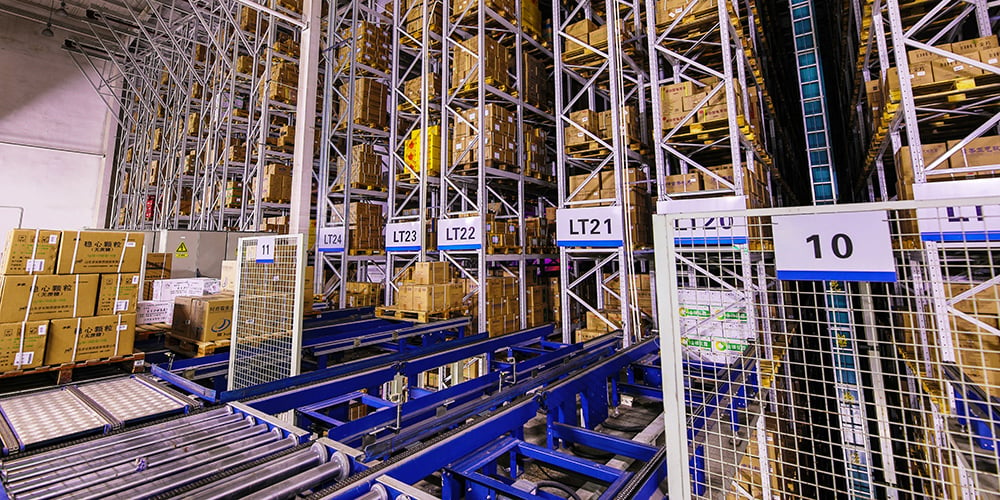

Warehouse automation solves labor constraints—not liability. Automated storage and retrieval systems (ASRS) are steel structures under load, subject to OSHA regulations, ANSI/MHI rack standards, and the same physics as traditional pallet racking. Automation doesn’t reduce risk; it increases the consequences of failure.
This guide explains what OSHA and MHI require, what makes ASRS racking uniquely demanding, and how to build an inspection program that protects uptime, employees, and your investment.
What Is an ASRS System?
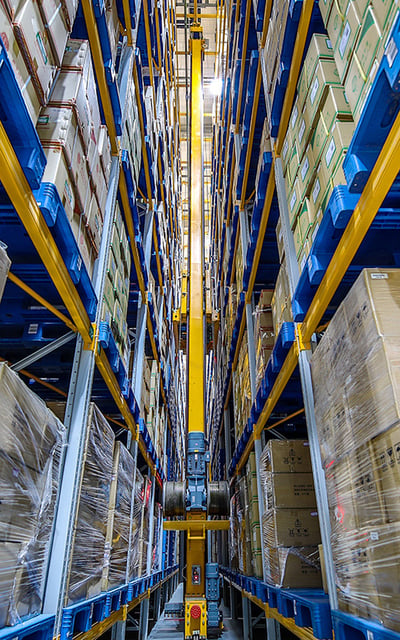
Automated storage and retrieval systems (ASRS) are computer-controlled solutions that automatically store and retrieve inventory with minimal human intervention. These systems pair engineered rack structures with cranes, shuttles, conveyors, and advanced warehouse software to maximize space and throughput.
Primary Functions of an ASRS in a Warehouse
- Automated placement and retrieval
- Real-time inventory tracking
- High-density vertical storage
- Batch picking and order fulfillment
- Buffering and staging for slow/medium movers
- Kitting and consolidation
- Secure storage of high-value items
- Replenishment for downstream picking
- Support for manufacturing components and tooling
- Retail order fulfillment at service counters
Common ASRS Technologies: Comparison Table
| ASRS Type | Typical Load Type | Ideal Use Case | Storage Height | Key Advantages |
|---|---|---|---|---|
| Unit-Load ASRS | Pallets (1,000+ lb) | High-bay pallet storage | 60–100+ ft | High-density, automated pallet handling |
| Mini-Load ASRS | Totes, trays, cartons | Small-item fulfillment | 20–60 ft | Fast picking, precise movement |
| Shuttle Systems | Totes & cartons | High-throughput order picking | Multi-level grid | Extremely fast, scalable |
| Vertical Lift Modules (VLMs) | Trays | Parts, tools, slow-medium movers | 15–40+ ft | Secure enclosed storage, saves floor space |
| Vertical Carousels | Shelves/carriers | Small parts & high-security items | 10–25 ft | Ergonomic access, compact footprint |
| Horizontal Carousels | Bins | High-speed picking of small SKUs | Low-medium height | Fast, compact, ideal for batching |
| Cube-Based (Robotic Grid) | Bins | Ultra-high density picking | Variable (grid height) | Highest density, flexible automation |
Do Automated Storage and Retrieval Systems Mean Zero Risk?
No. Automation reduces labor, but it does not eliminate structural risk. ASRS racks must remain stable, plumb, anchored, and capable of supporting the designated loads. These systems operate at height, with tight tolerances, and any deformation or misalignment can immediately affect safety, throughput, and equipment performance.
OSHA does not exempt automated facilities from safe storage, safe access, or lockout/tagout requirements. ANSI MH16.1 explicitly includes ASRS (“stacker racks”) and assigns owners responsibilities for inspection, repair, load plaques, and compliance.
Automation improves performance—but it doesn’t replace inspection and maintenance.
Photo Credit: MHI
What OSHA Actually Requires for ASRS Systems
OSHA’s safety rules apply to all storage systems, including manual, semi-automated, and fully automated systems. There are no exemptions for ASRS equipment.
Key OSHA Requirements
- 1910.176—Secure storage: Materials must be stored to prevent sliding, falling, or collapsing, including in high-bay ASRS aisles.
- 1926.250—Material stacking & overloading: Storage must be stable and not exceed capacity.
- 1910.22—Walking-working surfaces: Catwalks, platforms, and access areas must remain clean and unobstructed.
- 1910.147—Lockout/Tagout (LOTO): Mandatory during service of ASRS machinery, conveyors, or rack interfaces.
- General Duty Clause: Enforced when hazards such as damaged racks, missing load plaques, or unanchored frames are found.
Recent OSHA Violations
| Violation Type | Standard | Penalty (2025) |
|---|---|---|
| Improper storage | 29 CFR § 1910.176 | $0–$16,550 per violation |
| Lack of inspection/maintenance | General Duty Clause | Up to $161,000 (repeated) |
| Inadequate training | General Duty Clause | $0–$16,550 per violation |
| Obstructed aisles | 29 CFR § 1910.176 | $0–$16,550 per violation |
OSHA Interpretation Insight
OSHA’s interpretation letters confirm that automation does not change which standards apply. Employers must still inspect equipment, maintain safe storage conditions, and eliminate hazards—even if the system is fully automated.

What MHI/RMI Requires for ASRS Racks
ANSI MH16.1, published by MHI’s Rack Manufacturers Institute (RMI), is the primary rack standard in North America. Section 1.2 of MH16.1 explicitly includes automated storage and retrieval systems (“stacker racks”).
Additional ASRS Requirements (Section 12.4)
- Tolerances
- Vertical impact loads
- Horizontal loads
- Deflection limits
- Wind, snow, and roof live loads
- Rack-equipment compatibility
Owner Responsibilities
- Post-installation inspection
- Load capacity plaques and LARC drawings
- Controlled modifications
- Repair or replacement of damaged components
- Adherence to out-of-plumb/out-of-straight limits
If your rack supports an ASRS, you still own the rack and all the responsibilities that come with it.
Related Standards: ANSI MH24.2
For power-operated vertical carousels and vertical lift modules (VLMs), MH24.2 covers installation, operation, maintenance, and hazard control.
The Myth: “Automated Racks Don’t Need Inspection”—Debunked
Automated storage and retrieval systems rely on highly engineered structures, and when those structures fail, the consequences are amplified by the speed, height, and density of ASRS operations. Real-world incidents have shown that failures in automated racks can have severe consequences.
Two Real-World ASRS Incident Types
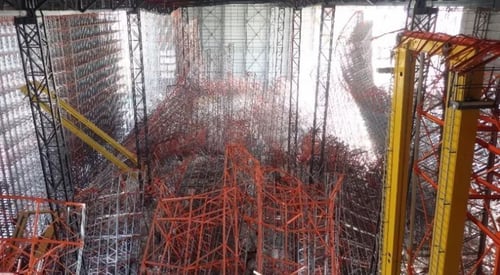 Rack Collapse
Critical load testing in a large automated warehouse resulted in a total rack failure, causing damage to both the structure and the building.
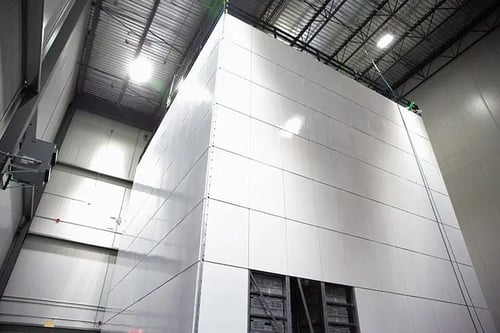 Fire Incident
A major fire at a Canadian Tire facility utilizing a high-density robotic ASRS (Attabotics) resulted in extensive damage and ultimately contributed to the ASRS provider’s downturn.
Lesson: Automation amplifies both productivity and risk. Regular inspection is not optional.
Best Practices: Inspection Protocols for ASRS Racks
ASRS racks require a structured, risk-based inspection program due to height, density, and tight tolerances.
How Often Should You Inspect ASRS Racking in a Warehouse?
- Daily: Operator walk-by checks for apparent damage, obstructions, alarms, or abnormal ASRS behavior
- Quarterly: Preventive maintenance inspections coordinated with rack—equipment interface review
- Annually: A comprehensive inspection by a qualified rack engineer
Risk-Based Guidance
| Condition | Recommended Frequency |
|---|---|
| All ASRS racks (minimum) | Annually, by a qualified professional |
| High-risk areas | Monthly |
| Medium-risk areas | Quarterly |
| Low-risk areas | Twice per year |
| After impact/seismic event | Immediately |
ASRS vs. Conventional Pallet Rack—Key Inspection Differences
Core inspection categories—uprights, bracing, beam connections, pallet and load conditions, and load plaques—remain the same in any racking system. What changes in an ASRS warehouse are the level of precision required: tighter tolerances, more frequent checks, and far less room for error.
ASRS-Specific Priorities
- Crane/shuttle rail alignment
- Rack-to-equipment clearances
- Cross-aisle ties and frame ties
- Baseplates and anchors
- Seismic separation
- Deflection and out-of-plumb limits
- Fall protection and flue-space management
A single misaligned rail or loose anchor can trigger emergency stops, equipment faults, or cascading damage.
Load Distribution Matters
Uneven loading accelerates wear and can cause misalignment, deformation, or structural failure. Balanced loads are crucial for the optimal performance of automated equipment.

Building an ASRS Rack Inspection Program: Step-by-Step Implementation
- Assign Ownership: Designate a rack safety manager or team.
- Establish Inspection Cadence: Use risk-based frequency (see table above).
- Train Staff and Supervisors: Ensure all relevant personnel are trained in hazard recognition and reporting.
- Document Everything: Keep detailed records of inspections, findings, and corrective actions.
- Review & Improve: Regularly update your program based on incidents, near-misses, and new standards. Schedule annual engineering reviews.
Fire Protection Requirements for ASRS Systems
ASRS systems pose an elevated fire risk due to their tightly packed storage and limited access.
NFPA & Insurance Requirements
NFPA standards emphasize the need to ensure that fire suppression systems can reach every level of a dense racking structure. Key considerations include:
- Unobstructed sprinkler coverage
- Minimum vertical flue spaces (often 6 inches)
- In-rack sprinklers when spacing cannot be maintained
- Integrated detection and alarm systems
Local Fire Authority Requirements
Local authorities having jurisdiction (AHJs) often impose additional conditions, such as:
- Engineering reviews
- Seismic anchoring and load certification
- Protection of egress paths and emergency equipment
Operational Fire-Safety
- Clear flue spaces
- Accessible extinguishers and alarms
- Functioning sensors and shutdown devices
- Staff trained on emergency procedures
Pair fire checks with regular ASRS rack inspections to catch issues early.
Conclusion: Protecting Your ASRS System with a Strong Inspection Program
Automation improves throughput, but inspection protects it. ASRS racking remains subject to physical damage, overloading, seismic forces, and fire risk, regardless of automation. OSHA and MHI/RMI both require owners to inspect, maintain, and document rack conditions for safe operation.
A strong ASRS safety program includes:
- Clear ownership of rack condition
- KPIs for issue severity and closure
- Regular staff training
- A reliable inspection and repair record system
When backed by structured inspections, your ASRS investment becomes safer, more reliable, and more resilient.

FAQ: ASRS Systems, Rack Inspections & Warehouse Safety
What is an ASRS system in a warehouse?

Does automated racking reduce the need for inspections?
What OSHA rules apply to automated storage and retrieval systems?
What does MHI/RMI require for ASRS racking?
What are the most common types of ASRS technologies?
How often should ASRS racking be inspected?
How is ASRS rack inspection different from conventional racking?
Do ASRS warehouses have additional fire protection requirements?
Why is load distribution important in automated racking?
How can a facility improve the safety of its ASRS warehouse?