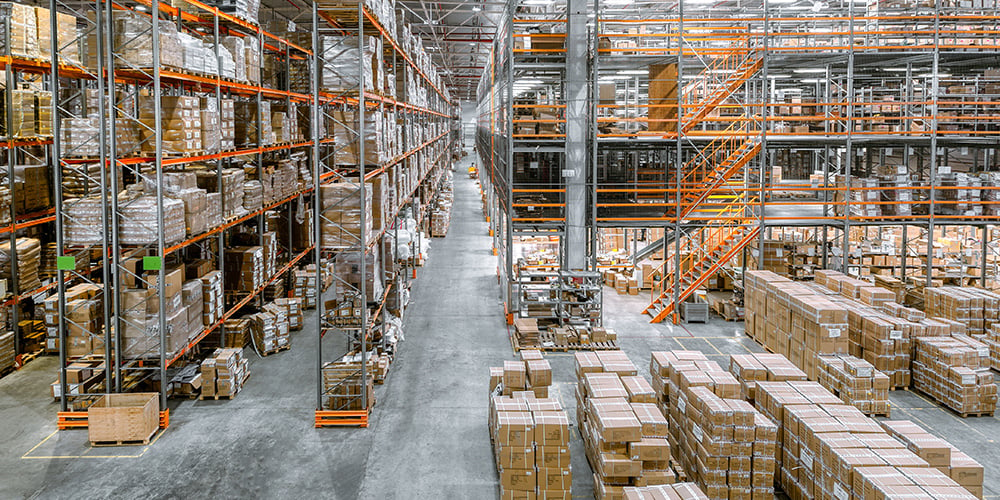

A pallet rack frame is the vertical upright assembly — two columns joined by horizontal and diagonal braces and bolted to the floor with baseplates — that carries every load on the rack down to the concrete. When a pallet rack frame is damaged, the load-carrying capacity of that rack bay may be affected, depending on the type and severity of the damage. This guide explains what causes pallet rack frame damage, how to inspect your uprights, how to tell repairable damage from damage that must be removed from service, and how to choose between repairing and replacing a frame.
If you already have a damaged pallet rack frame in your warehouse, do not keep loading that bay until a qualified rack professional has assessed it. Isolate the area and get a rack damage assessment.
Found Pallet Rack Frame Damage? Take These Steps First
- Stop loading the affected bay.
- Isolate or mark the area so forklift operators and warehouse personnel avoid it.
- Photograph the damage, including the uprights, braces, baseplates, anchors, and beam connections.
- Look for frame-specific warning signs, including leaning, twisting, dents, corrosion, missing braces, damaged punch holes, or lifted baseplates.
- Have the frame assessed by a qualified rack professional before returning it to service.
Next step: Once the area has been secured, determine the severity of the damage using our rack damage priority and classification guide and our 1-2-3 rule for rack damage assessment.
What Is a Pallet Rack Frame?
A pallet rack frame — also called an upright, an upright frame, or a pallet racking frame — is the largest and most load-critical component of a selective racking system.
Pallet Rack Frame Terminology: Frame vs. Upright vs. Column
Warehouse teams often use several terms to describe pallet rack frame components. Here is what each term usually means during inspections, repairs, and maintenance.
| Term | What it usually means |
|---|---|
| Pallet rack frame | The full upright assembly: front column, rear column, braces, and baseplates. |
| Upright frame | Another common name for the pallet rack frame. |
| Upright | Often used interchangeably with "frame," although some manufacturers use it to refer to the complete upright assembly. |
| Rack column | One vertical post within the frame, usually the front or rear column. |
| Brace | The horizontal or diagonal member connecting the two columns. |
Each frame is made of:
- Columns: the two vertical steel posts (front and rear) that carry the load.
- Braces: the horizontal and diagonal members that tie the two columns together and stabilize the frame across the aisle.
- Baseplates (footplates): the plates at the bottom of each column that spread the load onto the floor and provide the anchor points.
Beams connect to the frame columns and hold the pallets. The frame then transfers all of that weight from the beams to the floor. Because the frame is what keeps the system standing, keeping your uprights in good condition is one of the highest-priority items in any warehouse rack safety program.
Four Things That Define Your Frames
Frame uprights differ in a few ways that matter when you inspect, repair, or replace them:
- Steel type. Uprights are made from either structural steel or cold-formed (roll-formed) steel. Structural steel frames are often more impact-tolerant, depending on the rack design, profile, and application. Cold-formed frames are common because they are efficient and cost-effective, but damage can still reduce capacity and should be assessed.
- Hole (punch) pattern. The holes down the column are how beams connect. Patterns go by names like Teardrop, T-bolt, Speedrack, Sturdi-Built, Keystone, and Paltier, among others. The pattern affects which replacement or repair parts fit.
- Baseplate size. Every upright is engineered with a specific baseplate. Sizing depends on load and, in many regions, on seismic activity — higher-seismic areas typically use larger baseplates.
- Coating. Frames are finished with paint, powder coat, or galvanizing. Powder coating creates a durable cured finish, while galvanizing adds a zinc layer that helps resist corrosion. Both can perform better than standard paint in demanding environments when properly specified.
What Causes Pallet Rack Frame Damage?
Most frame damage comes from a handful of everyday warehouse causes. Knowing them helps your team catch problems early.
1. Forklift and Equipment Impacts
Uprights are not designed to absorb significant impact, so forklift contact is the leading cause of frame damage. Counterbalanced trucks tend to cause blunt hits — deformation, large dents, and twisting. Outriggers can create shearing impacts that cut into the steel or leave smaller, deeper dents. Pallets and products can also strike rear columns and braces during loading, and that rear damage is easy to miss from the aisle.
2. Improper Loads
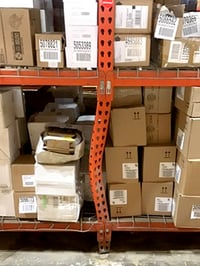
Overloading a beam level or loading it unevenly pushes stress into the frame. Because the two columns work as a pair to carry the beam load, an uneven load shifts weight onto one column. Over time that can lead to twisting, buckling, loss of plumb, or failure. Load within the capacities on your rack’s load plaque, and distribute weight evenly.
3. Upright Hole Damage
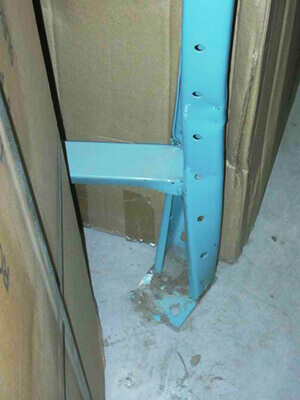
The column holes themselves can deform or shear after a hard impact or from irregular loading. This is a subtle failure mode: once the holes are damaged, that connection point should not be reused, even if the column looks mostly intact.
4. Corrosion and Rust
Humidity and chemicals attack unprotected steel, and corrosion is worst at welds and anywhere the coating has worn off. Corrosion also weakens fasteners in beam connectors, splices, and anchors. Powder-coated or galvanized finishes and corrosion-resistant (stainless or zinc-plated) fasteners hold up far better in demanding environments such as cold storage or food and beverage.
How Do You Inspect a Pallet Rack Frame for Damage?
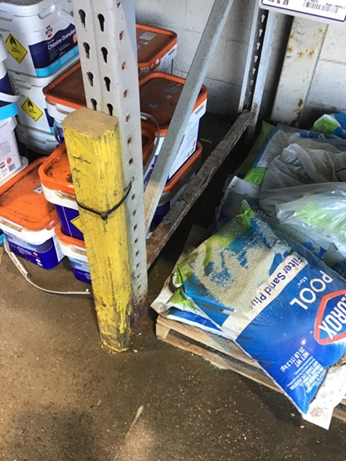
Every warehouse manager and operator should know how to spot damage on their pallet racking frames so it gets reported the same day it happens. Internal spot-checks are useful, but they do not replace a formal inspection by a qualified rack professional. Most experts recommend routine internal checks plus an annual professional inspection, with an additional look any time a frame takes a hit.
Here is what to check on the frame specifically. (This is frame-focused; a full rack inspection covers beams, connectors, anchors, and more.)
| Frame component | What to look for | Common threshold to act |
|---|---|---|
| Columns | Twisting, buckling, dents, deformation, shearing | Any visible bend or dent, especially at the base |
| Braces | Twisting, deformation, shearing, missing braces | Deflection roughly over 3/8" across a 40" span |
| Out-of-plumb lean | Frame leaning down-aisle or across-aisle | Lean of about 1/2" or more over 10 ft of height |
| Baseplates/anchors | Corrosion, shearing, twisting, deflection, loose or missing anchors, cracked concrete | Any loose anchor or lifted/cracked baseplate |
| Column holes | Deformed or sheared punch holes | Any damaged hole — do not reuse the connection |
| Corrosion | Rust that has penetrated the steel, especially at welds | Section loss or heavy rust at load-bearing welds |
A dent that looks minor can still matter: even a small deflection over a column can reduce that upright’s load capacity well below what it was designed to carry. When in doubt, treat it as unknown capacity and have it assessed.
Once you find damage, isolate the bay and bring in a qualified inspector to determine severity and the right corrective action. For a simple field method your team can use to sort damage by severity, see our 1-2-3 rule for assessing rack damage.
Want a printable version for your team? Order the rack inspection poster and keep it at the dock.

What Happens to a Frame That’s Beyond Limits?
When frame damage is beyond acceptable limits, the affected rack should be unloaded and taken out of service until it is repaired or the damaged parts are replaced — and then recertified to at least its original design capacity before the bay carries load again. From there, you have two paths for the frame itself: replace the upright with an original-equipment (OEM) part, or restore it with an engineered repair kit that bolts onto the existing upright.
Either way, the work should be done by trained installers and, per industry guidance, supervised by a professional engineer familiar with the system’s design.
Which path is right for your situation is its own decision — it depends on downtime tolerance, OEM lead times, recurring-impact risk, and long-term cost, not just the frame in front of you. We cover that decision in depth elsewhere so this page stays focused on the frame:
- Run the numbers with the repair vs. replacement ROI calculator.
- See the benefits of repair vs. replacement side by side.
- Choosing a kit: how to choose the right rack repair kit.
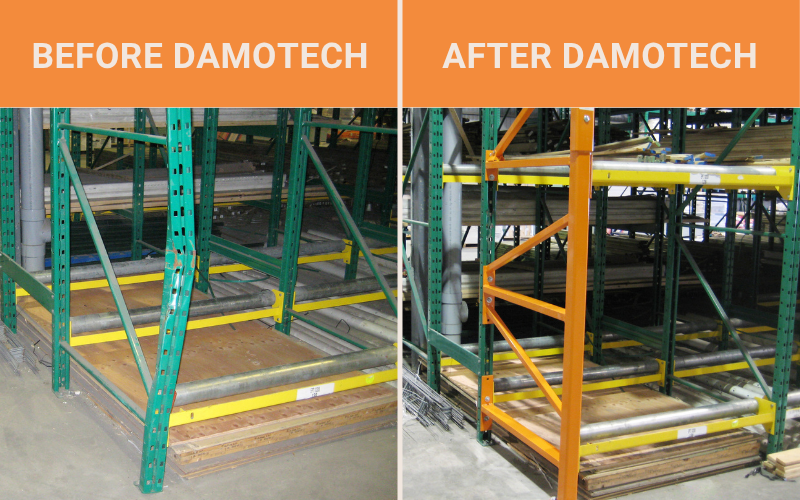
When Pallet Rack Frame Replacement May Be the Right Corrective Action
A damaged pallet rack frame is not always a candidate for repair. Replacement may be the better option when the frame is severely twisted, has multiple damaged load-carrying components, cannot be engineered for repair, or is being replaced as part of a larger rack reconfiguration. When damage is limited to the lower section of the upright, an engineered repair kit may restore the original design capacity with less disruption than replacing the entire frame.
For a full side-by-side of the two options — cost, downtime, and lead time — see repair vs. replacement.
How to Protect Frames From the Next Hit
Repairing a frame fixes today’s problem; guards keep the next impact from reaching the upright at all. The highest-payback move is to protect your recurring hit zones first — the specific aisles and positions that get struck again and again — which reduces repeat repairs, lost pallet positions, and emergency downtime.
Damotech’s protection line covers the main frame-exposure points: column guards (DAMO GUARD) with their own floor anchors so impact transfers to the concrete instead of the upright, end-of-aisle guards (DAMO END GUARD) for exposed frames at high-traffic aisle ends, and dock-door frame guards (DAMO FRAME GUARD) for the front posts near dock doors. Engineered repair kits can also include built-in protection so a restored frame is tougher than the original.
What Do Standards Say About Damaged Frames?
Rack safety in North America is shaped by a few different sources, and it helps to keep them separate:
- Regulation (U.S.): OSHA does not publish a rack-specific standard, but its General Duty Clause requires employers to keep the workplace free of recognized hazards — and OSHA references consensus standards when evaluating rack conditions.
- Consensus standard: ANSI MH16.1 (developed by the Rack Manufacturers Institute) is the primary industry standard for the design, testing, and use of steel storage racks. In plain terms, it places responsibility on the rack owner to maintain the system, and it directs owners who find damage to isolate the affected area and take corrective action. Before the rack goes back into service, a registered design professional should confirm the system or repaired parts have been restored to at least their original design capacity.
- Best practice: routine internal checks, an annual professional inspection, prompt reporting of every impact, and documented corrective actions.
Specific requirements vary by jurisdiction, rack type, facility use, and the authority having jurisdiction — so treat the above as the general framework and verify what applies to your site. Keeping your frames within their original engineering specifications is the through-line across all of them.

Keep Your Frames Safe and In Service
Pallet rack frames carry everything your racking holds, so damaged uprights are one of the fastest ways a warehouse goes from productive to hazardous. Impacts, uneven loads, corrosion, and hole damage all chip away at a frame’s capacity — sometimes invisibly. Catch it early with trained operators and routine checks, confirm it with a professional inspection, and restore it with a repair or replacement that returns the frame to its original design capacity.
If you have a damaged frame right now, request a free rack damage assessment. If you want a documented baseline across your racking, book a rack inspection. Damotech engineers repair kits and guards tailored to your system — across brands, types, and punch styles — so you can keep your warehouse safe with less disruption.
Frequently Asked Questions on Pallet Rack Frames
What is a pallet rack frame?

What is the most common type of pallet rack frame damage?
Can a bent pallet rack frame be repaired?
When should a damaged frame be taken out of service?
How much load capacity does frame damage remove?
How often should pallet rack frames be inspected?