
Pallet rack uprights are a mission-critical component of your warehouse pallet rack system. This article aims to increase your knowledge so you can run your warehouse safely and efficiently. Small details missed on your racking uprights can lead to significant disruptions—or even a catastrophic rack collapse. Keep reading for the essential insights and the key warehouse manager responsibilities required to maintain a safe, efficient storage facility.
What Are Pallet Rack Uprights?
Pallet rack uprights are the vertical frames that carry the entire load of a pallet rack system. Each upright is made up of two columns (a front and a rear post) joined by horizontal and diagonal braces, and anchored to the floor through a footplate. The beams that hold your pallets connect directly to these uprights, so the upright frame—not the beam—is what ultimately transfers stored weight down to the concrete slab.
Because they bear the load and sit directly in the path of forklift traffic, uprights are both the most important and the most frequently damaged part of the rack. A single bent front column in a high-traffic bay can reduce the capacity of the whole frame, which is why understanding how uprights are specified, inspected, and repaired matters for anyone responsible for warehouse safety.
Rack Uprights vs. Warehouse Uprights: A Quick Note on Terminology
“Rack uprights” and “warehouse uprights” refer to the same component: the vertical load-bearing frame of a pallet rack. You may also hear them called upright frames, rack frames, or simply columns (though a column is technically one of the two posts that make up a frame). Whatever your team calls them, they perform the same job—holding the beams and transferring pallet loads safely to the floor. This guide uses “pallet rack uprights” throughout.
Essential Information About Pallet Rack Uprights and Warehouse Manager Responsibilities
Here are five critical concepts about uprights that warehouse managers need to understand thoroughly:
- Engineering design regarding upright and beam spacing
- Two basic types of upright racking
- Punch style
- Width, height, depth, and splicing
- Footplate size
1. Engineering Dictates Upright Racking Choices and Beam Spacing Design
Racking systems are engineered to store palletized goods safely and densely, maximizing both space and safety. Every warehouse pallet rack system must be designed to support a specific product weight, size, and shipping flow. Engineering dictates what type of racking upright your system uses and how it is configured.
Experienced warehouse and maintenance managers never cut corners by skipping an engineering review when one is needed—including before changing beam spacing from the original as-built drawings. They never buy a new or used rack without having an engineer review the design first. Always make sure the uprights and racking system are designed to support your product safely. Keep the load application and rack configuration (LARC) drawings available for review, and don’t change beam levels without engineering approval.
2. Two Basic Types of Upright Racking
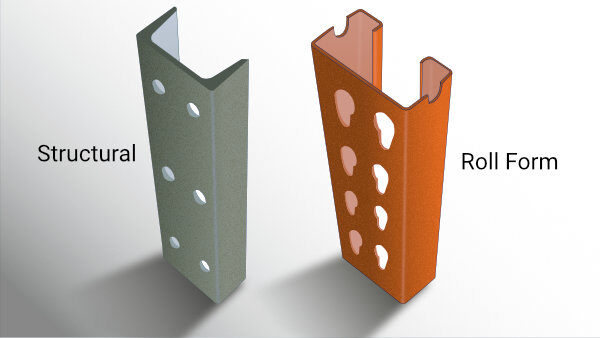
Racking uprights fall into two main categories based on the type of steel they are made from:
- Roll-formed steel racking uprights
- Structural steel racking uprights
Roll-formed steel uprights are the most common form of pallet rack upright. They are less expensive, versatile, and widely compatible, which makes them the most popular choice for general warehouse use.
Structural steel pallet rack uprights are generally stronger and more impact-resistant than roll-formed uprights. They are typically used in more demanding environments and higher-traffic applications.
3. Hole Punch Styles
The hole punch styles on the front and sides of pallet rack uprights connect beams, spacers, arms, and other attachments. Many punch types appear on upright frames. The following styles are commonly found on rack systems in North America: teardrop, slotted, rectangle t-bolted, round-hole hex-head bolted, round corner clipped, corner slotted with steel clips, and keystone.
The teardrop punch style is one of the most popular designs for roll-formed upright frames. Many manufacturers produce it because of its wide compatibility, easy beam adjustability, and broad adoption across North America.
Teardrop beams use lugs that connect quickly and securely to the upright posts. Bolted-style frames—such as structural steel uprights—use rectangular or rounded holes for attachment, which are more durable and impact-resistant but take longer to assemble and disassemble.

4. Pallet Rack Upright Specifications: Width, Height, Depth, and Splicing
Uprights come in a range of column sizes, heights, and frame depths. As a general rule, larger columns are engineered to carry more weight than smaller ones—but always confirm capacity against your engineered design and load plaque, not the column size alone. The table below summarizes the typical specifications referenced in this article.
| Specification | Roll-Formed Uprights | Structural Uprights |
|---|---|---|
| Typical column size (W × D) | 4" × 3", 3" × 3", 3-1/4" × 2", 3" × 1-5/8" | 3" × 1-3/8", 4" × 1-1/2" |
| Relative strength | Lighter-duty; larger columns carry more | Stronger and more impact-resistant |
| Height range | 8–40 ft. 16–28 ft is most common. | |
| Frame depth | 24"–96". Standard depths are 42"–54". | |
| Splicing | Only per the manufacturer’s design specs. Consult the OEM or a professional engineer first. | |
Uprights can be spliced together to reach a designed height, but splicing must follow the manufacturer’s specifications exactly. Never splice pallet rack uprights without first consulting the original manufacturer or a professional engineer familiar with the design and construction of pallet racking. The horizontal and diagonal braces are what maintain the frame’s depth and cross-aisle stability.
5. Footplate Size
The footplate—also called the baseplate or anchor plate—is a steel plate at the base of each upright column, and it’s critical to every upright pallet rack. The footplate secures the upright to the floor with anchor bolts driven into the concrete foundation, and it distributes the column load over a larger area to prevent shifting or tipping. Anchoring keeps the system from moving under loading, forklift impacts, and seismic activity.
Never install an upright without properly anchoring each footplate—at minimum one anchor per column, or the number the manufacturer specifies. Footplates are engineered for the specific application, and their design is especially important in high-seismic zones, where proper anchoring helps reduce the risk of collapse during an earthquake. For how to spot and fix footplate damage, see our guide on pallet rack footplate damage and repair.
Upright Racking System: How the Components Work Together
A pallet rack upright doesn’t carry load in isolation. In an upright racking system, the front and rear columns, the horizontal and diagonal braces, the footplates, and the floor anchors all act as a single load path from your pallets down to the slab. Damage to any one of them changes how the whole frame behaves.
Alignment matters too: an upright that leans out of true (out-of-plumb) changes how that load path behaves. We cover the allowable tolerances and how to check for them in a separate guide, Pallet Rack Stability: Out-of-Plumb Uprights Explained. Understanding the upright racking system as a whole is what lets you catch a small problem before it becomes a structural one.
Warehouse Manager Responsibilities for Maintaining Your Racks
A key warehouse manager responsibility is to ensure racks are inspected regularly and that identified damage is repaired promptly, before it disrupts operations or compromises safety.
Professional Inspections for Your Pallet Racks
Rack safety in North America is governed by consensus standards—ANSI MH16.1 in the U.S. (published by the Rack Manufacturers Institute, RMI) and CSA A344 in Canada. These standards call for racking systems to be inspected regularly by qualified inspectors. In the U.S., OSHA can enforce rack safety under its General Duty Clause when a recognized hazard exists, which makes documented inspections part of a defensible safety program. Damotech’s professional inspection teams help you inspect your racking and keep audit-ready documentation aligned with these standards.
Internal Inspections
Empowering your team to run informal inspections between the professional ones is another way to meet your warehouse manager responsibilities. You and your team should constantly scan for impact damage and non-compliance. These informal inspections augment—but don’t replace—regular professional inspections. Make sure employees are aware of and empowered to conduct them, and educate the team on the most common issues found during rack inspections so they can tell a maintenance issue from severe damage. If any damage or question comes up, call your Damotech professional right away.
Free Pallet Rack Inspection Poster
Request Damotech’s free poster to help your warehouse staff identify damage and maintenance issues. This tool helps employees recognize the warning signs that need attention, supporting a safer, better-maintained workplace.

Where Uprights Get Hit Most in Your Warehouse
Some pallet rack uprights are far more vulnerable to impact simply because of where they sit. Which positions take the most damage depends on the type of rack system.
Selective Racking
For selective (single-deep) racking, the typical damage points are the end of the aisle and tunnel locations.
Very Narrow Aisle (VNA) Racking
The first two or three uprights on either side of a VNA aisle entry are the most vulnerable. As lift equipment enters, its lock-on guidance system may not engage for the length of those first few uprights—either because the operator doesn’t give the equipment time to lock onto the wire, or because it’s misaligned and can’t lock on.
Single Standing Row of Racking
Every free-standing row is more vulnerable to collapse when a frame is damaged, because its footprint is small compared with a back-to-back rack. A single selective frame might have a 42" footprint; the same frame back-to-back, with a 12" row spacer, has a 96" footprint.
Double-Deep Rack Systems
Double-deep systems are used when high-density storage is needed, and they work best when the same product or SKU is stored in bulk.
They have a built-in problem: once the lower shelves are loaded, the operator can’t see the second-deep (furthest) pallet position. Operators line up as best they can, extend the forklift to maximum reach, and set the pallet down blind. This often causes beam, frame, and brace damage in the first and second frames (posts one through four).
Wire decks and crossbars can also be damaged by this blind entry. Some modern forklifts have a mast-mounted camera and an in-cab screen so operators can see pallet height as they load, which reduces the damage but doesn’t eliminate it.
Drive-In and Drive-Through Rack Systems
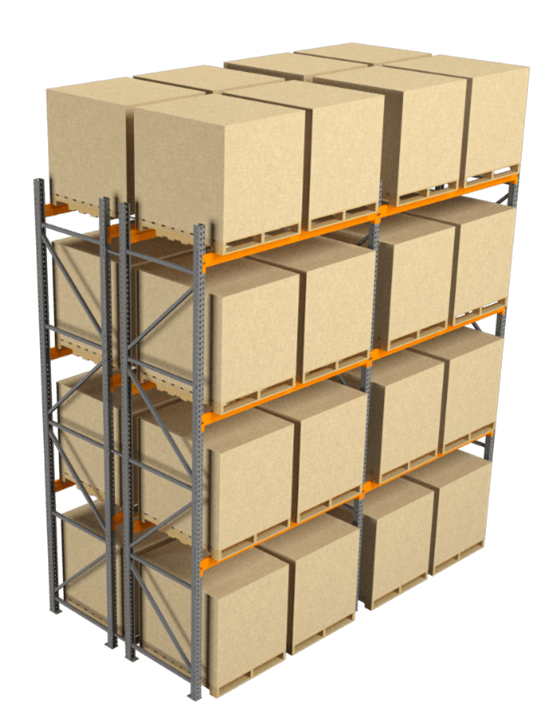
All columns in drive-in and drive-through systems—including interior columns—are prone to damage. Lift equipment travels between the frames in a narrow lane without electronic guidance; the operator steers the truck in and out and sets pallets onto the left and right rails.
Much of the damage happens when the forklift backs out after placing a pallet. Operators often accelerate on the way out, sometimes in a cold environment like a freezer or a high-volume line where pallets are coming off production fast.
Pushback Racking
Pushback racking is not the same as drive-in or drive-through. Damage on pushback is almost always confined to the front frame post. As the operator turns a pallet into the bay and sets it on the pushback cart or rails, the corner of the pallet or product strikes a horizontal or diagonal brace, damaging the frame bracing.
Pallet Flow Racks
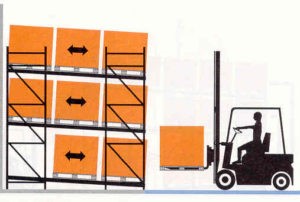
Pallet flow racks have an input side and an output side with long lanes between them, which creates two vulnerable impact zones:
- The front frame post on the input (loading) side.
- The front frame post on the output (retrieval) side.
- The entry and exit bracing and beams can also take severe damage, which in turn can damage the frame posts.
What to Do With a Damaged Upright
If you notice a bent column, damaged brace, deformed footplate, missing anchor, or an upright that appears out of plumb, don’t treat it as a cosmetic issue. The affected area should be reviewed by a qualified rack professional to determine whether unloading, repair, replacement, or protection is required. For a deeper breakdown of damage assessment and the repair vs. replacement decision, see our guide to pallet rack frame damage and upright repair.
Upgrade When You Repair
Damage tends to recur in the same spot because of traffic patterns. So when a vulnerable upright is damaged, it’s an opportunity to upgrade its impact resistance and strength—the reasoning behind choosing an engineered repair kit over a like-for-like replacement. Here are three ways Damotech repair kits upgrade an upright:
Higher Grade of Steel
Our repair kits let you repair with roll-formed or structural steel. Structural steel can be added to a roll-formed rack for even greater strength and impact resistance.
Additional Anchor Points
Damotech baseplates are built to match or exceed the thickness of standard OEM baseplates. They’re also longer, moving the anchor points to new locations behind the frame post to help keep equipment and anchors out of the impact zone. Each upright needs at least one anchor per column (two per upright); high-seismic areas may require more.
Additional Rack Protection
Many warehouse managers plan ahead and invest in column guards to help prevent damage before it happens. Not all guards are equal—avoid plastic guards that bolt directly to the column, because they can transfer impact straight into the frame post you’re trying to protect.
Pallet Rack Uprights FAQ
What are pallet rack uprights?

Pallet rack uprights are the vertical frames that carry the load of a pallet rack system. Each upright has a front and a rear column joined by horizontal and diagonal braces and anchored to the floor with a footplate. The beams that hold your pallets attach to the uprights, so the upright frame—not the beam—is what transfers stored weight down to the slab.
What is the difference between roll-formed and structural pallet rack uprights?
Roll-formed uprights are made from bent sheet steel—lighter, less expensive, and the most common choice for general warehouse storage. Structural uprights are made from heavier hot-rolled steel, so they are stronger and more impact-resistant and are used in higher-traffic or more demanding environments.
What punch styles are used on pallet rack uprights?
Common North American punch styles include teardrop, slotted, rectangle t-bolted, round-hole hex-head bolted, round corner clipped, corner slotted with steel clips, and keystone. Teardrop is the most common roll-formed style because its lugs let beams connect and adjust quickly.
Can pallet rack uprights be spliced to make them taller?
Yes. Uprights can be spliced to reach a designed height, but only following the manufacturer's specifications. Never splice an upright without first consulting the original manufacturer or a professional engineer familiar with the rack’s design.
What is an upright racking system?
An upright racking system is the complete load path—front and rear columns, horizontal and diagonal braces, footplates, and floor anchors—working together to transfer pallet loads to the floor. Because the parts act as one system, damage or misalignment in any single component changes how the whole frame carries load.
What are the standard pallet rack upright sizes?
Roll-formed columns commonly come in 4"×3", 3"×3", 3-1/4"×2", and 3"×1-5/8"; structural columns are typically 3"×1-3/8" or 4"×1-1/2". Uprights range from 8 to 40 ft tall (16–28 ft is most common), with frame depths from 24" to 96" (42"–54" is standard). Larger columns generally carry more weight, but always confirm capacity against your engineered design and load plaque.
Conclusion: Maintain Your Pallet Rack Uprights
Pallet rack uprights are the core of any warehouse racking system. Damotech has upright repair kits engineered to restore the original load capacity of a damaged upright. Maintaining and protecting your uprights with Damotech is another critical step in keeping your racks safe and running efficiently. Contact us with any questions or for assistance.
Keep your facility safe, and let your warehouse team go home to their families safely at the end of every shift.