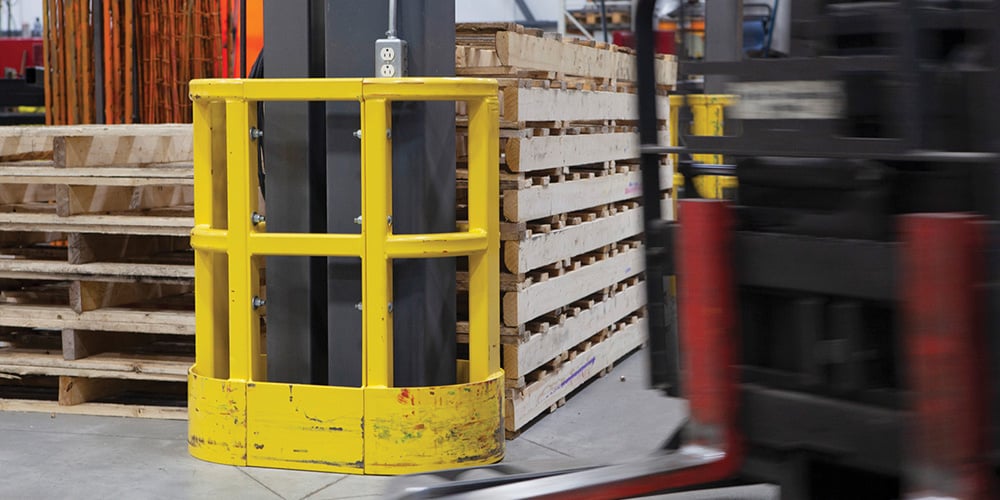

A forklift impact can damage a rack upright and reduce the system’s load-carrying capacity. Depending on the damage and loading conditions, the consequences can include falling inventory, disruption, or rack collapse. Properly selected protectors help reduce impact damage as part of a safety program that includes operator training, inspections, and prompt corrective action.
The right protector varies by location. Row ends, dock areas, narrow aisles, and building columns face different traffic conditions and protection needs. This guide covers six common categories of rack and warehouse protection, followed by design considerations that affect product selection. Use it to help plan protection for your facility and explore the Damotech protection products linked throughout.
Key takeaways
- This guide covers six common categories of rack and warehouse protection: end-of-aisle guards, upright protectors, guardrails and fences, dock-area rack guards, building column guards, and floor-level pallet stoppers.
- Choose protection based on applicable requirements, location, documented product performance, operating clearances, and budget.
- A protection plan may combine several products to address different hazards. Guards complement operator training, inspections, and corrective action.
- RMI provides guidance on rack protection. ANSI MH16.1-2023 addresses the design, testing, and utilization of industrial steel storage racks within its scope.
Choosing the best rack protector for your situation
Pallet rack systems vary widely in design, layout, and traffic, so there is no single "best" protector — only the best fit for a given zone and budget. Four factors drive the decision:
- Compliance and standards
- Location in your warehouse
- Design of the guard
- Budget
Select protection that meets applicable requirements and preserves safe operating clearances. Within those constraints, compare coverage, performance, installation needs, and cost.
Factor 1: Regulations and compliance
Several organizations influence rack safety and protective guarding. Their roles differ, so distinguish regulatory requirements from industry standards and recommendations.

ProGMA: protective guarding guidance
The Protective Guarding Manufacturers Association (ProGMA), an industry group within MHI, develops educational resources and standards for protective guarding. Damotech is a ProGMA member.
When planning protection, consider exposed rack columns, row ends, pedestrian routes, and other locations where equipment contact could cause harm. Include guards in routine inspections and train operators to work safely around them.

ANSI MH16.1-2023: rack design and utilization
ANSI MH16.1-2023 addresses the structural design, testing, and utilization of industrial steel storage racks within its scope. Applicable requirements depend on the rack type and governing codes. The standard provides context for maintaining rack integrity; it does not establish the impact performance of a particular guard.

OSHA: workplace hazard requirements
OSHA’s general material-handling requirements do not specify a particular pallet rack protector. However, employers must address applicable workplace hazards. The General Duty Clause requires a workplace free from recognized hazards causing or likely to cause death or serious physical harm.
Related requirements include:
- 1910.176(a): Provide sufficient safe clearances for material-handling equipment and keep aisles and passageways clear and in good repair.
- 1910.176(b): Store materials securely so storage does not create a hazard.
OSHA’s National Emphasis Program targets warehousing and distribution operations for inspections. Properly selected guarding can help address identified impact hazards, but installing guards alone does not establish OSHA compliance.
For help evaluating your facility’s rack condition and applicable requirements, explore Damotech’s compliance inspections.

Factor 2: Location in the warehouse — the 6 types of pallet rack protectors
The location and potential hazards help determine the protection needed. The table below groups six common categories by application.
| Protector type | What it protects | Damotech product | Use it when |
|---|---|---|---|
| End-of-aisle guards | Exposed row-end and tunnel frames | DAMO END GUARD, DAMO AISLE GUARD | Forklifts turn into or past the ends of your rows |
| Bottom-of-column (upright) protectors | The lower front of rack columns | DAMO GUARD, DAMO BASE GUARD, DAMO NOSE GUARD | Impacts concentrate in the bottom of the upright |
| Guardrails, fences, and bollards | Aisle edges, walkways, crossings | DAMO FENCE, DAMO BOLLARD | You need physical barriers along walkways or around infrastructure |
| Dock door guards | Rack frames beside dock doors | DAMO FRAME GUARD | Racking sits in busy, tight dock areas |
| Building column guards | Free-standing structural building columns | DAMO SHIELD | A struck building column could compromise the structure |
| Pallet stoppers | Ground-level bays and back frames | DAMO PALLET STOPPER | Ground-level pallets could contact rear frames, walls, or adjacent pallets |
1. End-of-aisle guards
Row ends and tunnel frames can be particularly exposed to contact as forklifts turn or move between aisles. Properly selected end-of-aisle guards help shield these frames from impact damage. RMI identifies row ends, cross-aisles, and tunnel bays as locations where protection should be considered.
Damotech products for this zone: DAMO END GUARD for floor-level end-of-row protection, and DAMO AISLE GUARD for end-of-row and tunnel-frame protection. Confirm that the selected guard preserves the operating clearances required by your layout and equipment.
2. Bottom-of-column (upright) protectors
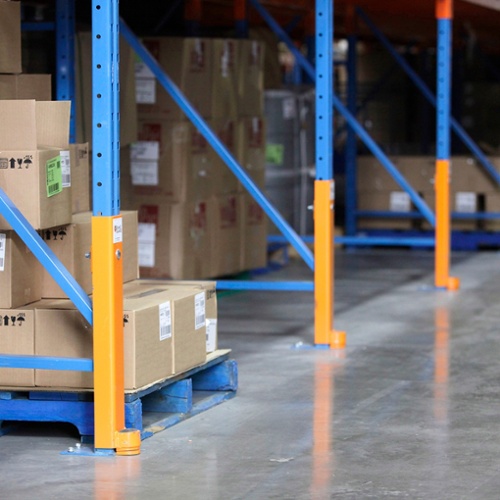
The lower portion of rack uprights is commonly exposed to forklift, fork, and outrigger contact. Upright protectors help shield this area. Depending on their design and attachment, floor-anchored guards can transfer part of an impact load into the concrete slab and reduce the load transmitted to the upright. A protector does not repair existing damage or establish that a damaged rack is safe to use.
Damotech products for this zone: DAMO GUARD for the front of the column, DAMO BASE GUARD when you need a low-profile guard that still allows beam installation near floor level, and DAMO NOSE GUARD for outrigger contact at the base.
3. Guardrails, fences, and bollards
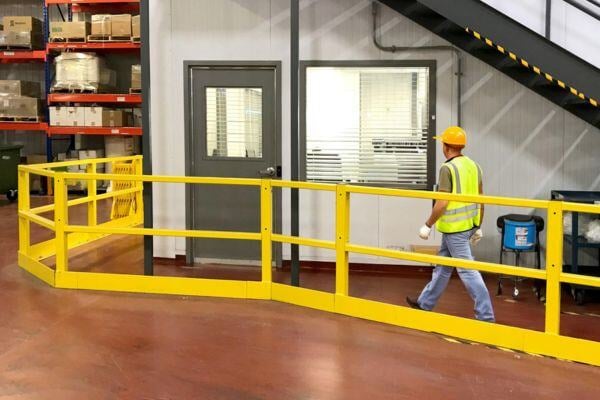
Guardrails and fences can provide physical separation around walkways, equipment, and infrastructure. Select the barrier and its placement for the expected vehicle impacts, allowing for its documented deflection and required clearance from the protected area. Bollards provide localized protection at selected points.
Damotech products for this zone: DAMO FENCE for continuous sections of steel guarding, and DAMO BOLLARD for localized protection around selected equipment and infrastructure.
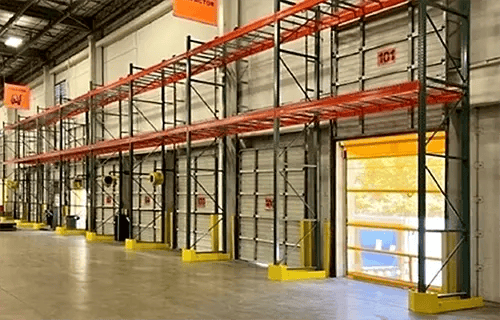
4. Dock door guards
Rack frames near dock doors can be exposed to contact from forklifts, pallet jacks, and handled loads. Dock-area guards help reduce impact damage to these frames and the associated risk of operational disruption.
Damotech product for this zone: DAMO FRAME GUARD, built for rack frames adjacent to dock doors.
5. Building column guards
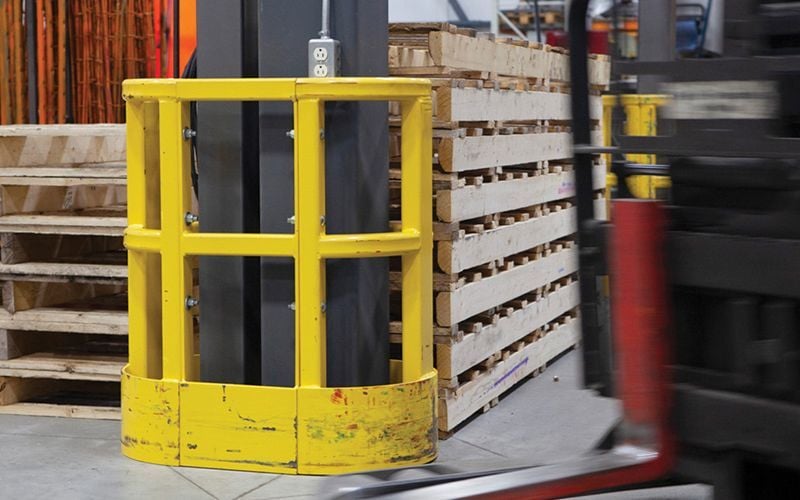
Building columns support the building structure and may require protection where vehicles operate nearby. Independently floor-anchored guards can help reduce direct vehicle contact. Select the guard and its clearance to suit the expected impact exposure.
Damotech product for this zone: DAMO SHIELD, an all-steel free-standing building column protector.
6. Pallet stoppers
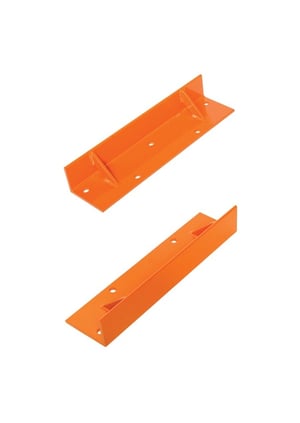
Floor-level pallet stoppers help limit pallet travel toward rear frames, walls, or pallets in adjacent rows. Select and position them for the pallet dimensions, operating conditions, and required clearances. Do not rely on a pallet stopper alone to protect pedestrians or contain falling goods.
Damotech products for this zone: DAMO PALLET STOPPER for existing installations.
Factor 3: Design features to weigh
Once you know the zone, the design of the guard decides how well it holds up. These are the trade-offs that matter.
Material: steel vs. plastic
Steel and polymer protectors are available in different designs and performance levels. Compare the specific product’s documented impact performance, attachment method, clearance requirements, environmental suitability, and maintenance needs. Material alone does not determine how a guard will perform.
Floor-anchored vs. rack-mounted
Guards may attach to the floor, the rack, or both. Compare how the complete design manages impact loads and whether the slab, anchors, and rack attachments suit the application. Follow the manufacturer’s installation requirements.
Protected vs. exposed anchors
Shielding anchors can reduce direct contact from equipment. Check the complete installation for trip hazards, adequate clearances, and access for inspection and maintenance.
Protruding vs. non-protruding
Choose the guard’s profile and stand-off distance to preserve equipment, pallet, and beam clearances. Allow for any movement or deflection specified by the manufacturer. Confirm suitability for the actual layout, particularly in narrow aisles and rack systems with moving components.
Short vs. tall
Guard height determines the area covered. Select it for likely contact heights and operating clearances. Assess impact resistance separately; a taller guard does not automatically withstand a stronger impact.
Steel thickness and strength
Steel thickness contributes to performance alongside material properties, shape, fabrication, anchorage, and impact height. Compare the complete design and available test data rather than relying on thickness alone.
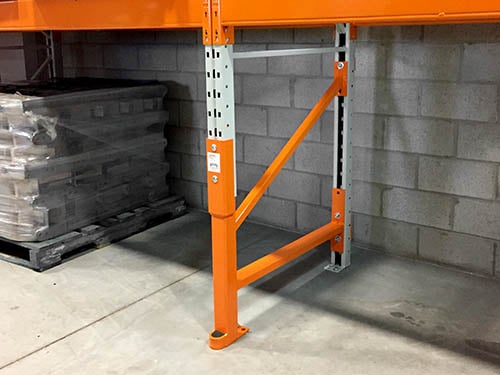
Repair kits with integrated protectors
Where damage is suitable for engineered repair, a kit such as DAMO PRO can restore the affected upright’s structural capacity while adding impact protection. A qualified rack engineer should determine the appropriate repair and installation procedure. Keep the affected area out of service until the required corrective work and return-to-service conditions have been completed.
If your racks already show damage, start with a qualified assessment to determine the appropriate corrective action.
Factor 4: Budget
Prioritize protection according to the likelihood and potential consequences of an impact. Consider pedestrian exposure, traffic patterns, operating clearances, and damage history. Row ends, dock areas, and locations with recurring contact may warrant particular attention. Budget phasing should not delay necessary controls for an identified safety hazard.
You don't have to plan it alone. Damotech’s team can help you map impact zones and match a protector to each one. Compare the full protection product line or talk to a rack safety expert.
Include guards and their attachments in routine inspections. After an impact, check the guard, anchors, surrounding concrete, and rack for damage. When structural rack damage is found, immediately isolate the affected area, prevent further use, and arrange prompt qualified assessment and safe unloading. If the rack or load appears unstable, keep personnel clear and obtain qualified direction before attempting to unload it.
Conclusion: choosing the right pallet rack protectors
Properly selected rack protectors can help reduce impact damage and its associated repair costs and disruption. Identify the hazards at each location, preserve safe operating clearances, and select products suited to the expected impacts. Combine protection with operator training, inspections, and prompt corrective action.
If your racks are already damaged, qualified assessment and appropriate corrective action come first. A guard does not repair a damaged upright. For help identifying repair needs and discussing available solutions, request a free rack damage assessment.

Frequently Asked Questions About Pallet Rack Protectors
How much do pallet rack protectors cost?

Damotech quotes protection projects based on the selected products, dimensions, quantity, delivery location, freight, and installation scope. Request a quote for pricing that reflects your facility’s requirements.
Are pallet rack protectors required by OSHA?
OSHA’s general material-handling requirements do not specify a particular pallet rack protector. Employers must still address applicable workplace hazards, provide safe operating clearances, and store materials securely. Properly selected guarding can help address identified impact hazards, but guards alone do not establish OSHA compliance.
What are the main types of pallet rack protectors?
This guide covers six common categories of rack and warehouse protection: end-of-aisle guards, upright protectors, guardrails and fences, dock-area rack guards, building column guards, and floor-level pallet stoppers. Each addresses different locations and potential hazards.
How do you install pallet rack post protectors?
Installation depends on the product. Follow the manufacturer’s instructions, including requirements for the concrete slab, anchor selection, spacing, edge distances, rack attachments, and operating clearances. A trained maintenance team or qualified installation provider can perform the work, depending on the product and site requirements.
Are steel or plastic rack protectors better?
Neither material alone determines protection. Compare the specific product’s documented impact performance, attachment method, operating clearances, environmental suitability, and maintenance requirements. Select a design suited to the impacts expected at that location.
What height of rack protector do I need?
Select the height based on likely contact points, equipment, and operating clearances. DAMO GUARD is available in 24-, 36-, and 48-inch heights. Taller guards cover more of the upright, but height alone does not determine impact resistance.
Are pallet rack protectors worth it?
Protection can be a cost-effective investment in exposed locations. Compare the installed cost with the likely repair, replacement, and disruption costs associated with damage at that location. The benefit depends on the product selected and the facility’s operating conditions.
Where should you install rack protection first?
Prioritize locations based on pedestrian exposure, traffic patterns, damage history, and the potential consequences of an impact. Row ends, dock areas, tunnel frames, and locations with recurring contact may require particular attention. Confirm that the protection preserves safe operating clearances.
How do I know which protector to use in my warehouse?
Identify the location, potential impacts, equipment, and available clearances. Have the supplier or a qualified specialist confirm product suitability and attachment requirements. Involve a qualified engineer where structural assessment or design is needed.